
Adulttoymegastore's Mega Kiwi Sex Survey 2025/2026

The Mega Kiwi Sex Survey is back and bigger than ever! Adulttoymegastore teamed up with the Sunday Star Times to commence a nationwide sex survey in December 2025. We wanted to better understand how Kiwis think and feel about sex, their sexual satisfaction, sexual behaviours, kinks, and so much more. The survey had 4850 participants aged 18+ from across New Zealand.
Survey demographics and methodology
We used a mixed-method survey using quantitative & qualitative research methods to understand the sexual habits and interests of a diverse range of participants across New Zealand. The study involved a self-reported survey hosted online. There were two sample sources for the survey. The link was shared with the Adulttoymegastore email database and also featured on the Sunday Star Times website.
The survey included 81 questions about the sexual and relationship attitudes and behaviours of the respondents. Topics covered included dating, sex, pornography, sex education, kinks and fantasies.
In total, 4850 Kiwis completed the survey. Participants ranged in age from 18 to 75+. 29% were Gen Z, 47% were Millennials, 18% were Gen X, and 5% were Boomers. Of our participants, women made up 50%, men 46%, and 4% were non-binary or trans. Our participants also covered a broad range of sexual orientations. 69% were heterosexual, 18% were bisexual, 4% were pansexual, 2% were gay, 2% were lesbian, 1% were fluid, and 1% were asexual.
The survey was in the field from December 2025 to January 2026.
Survey Contents
- 01. Partnered Sex & Sexual Satisfaction
- 02. Dating & Relationships
- 03. Sex Drive & Libido
- 04. Masturbation
- 05. Experimentation & Kinks
- 06. Sex Toys
- 07. Pornography
- 08. Sex Education
- 09. Safer Sex
Survey Key Findings

01. Partnered Sex & Sexual Satisfaction
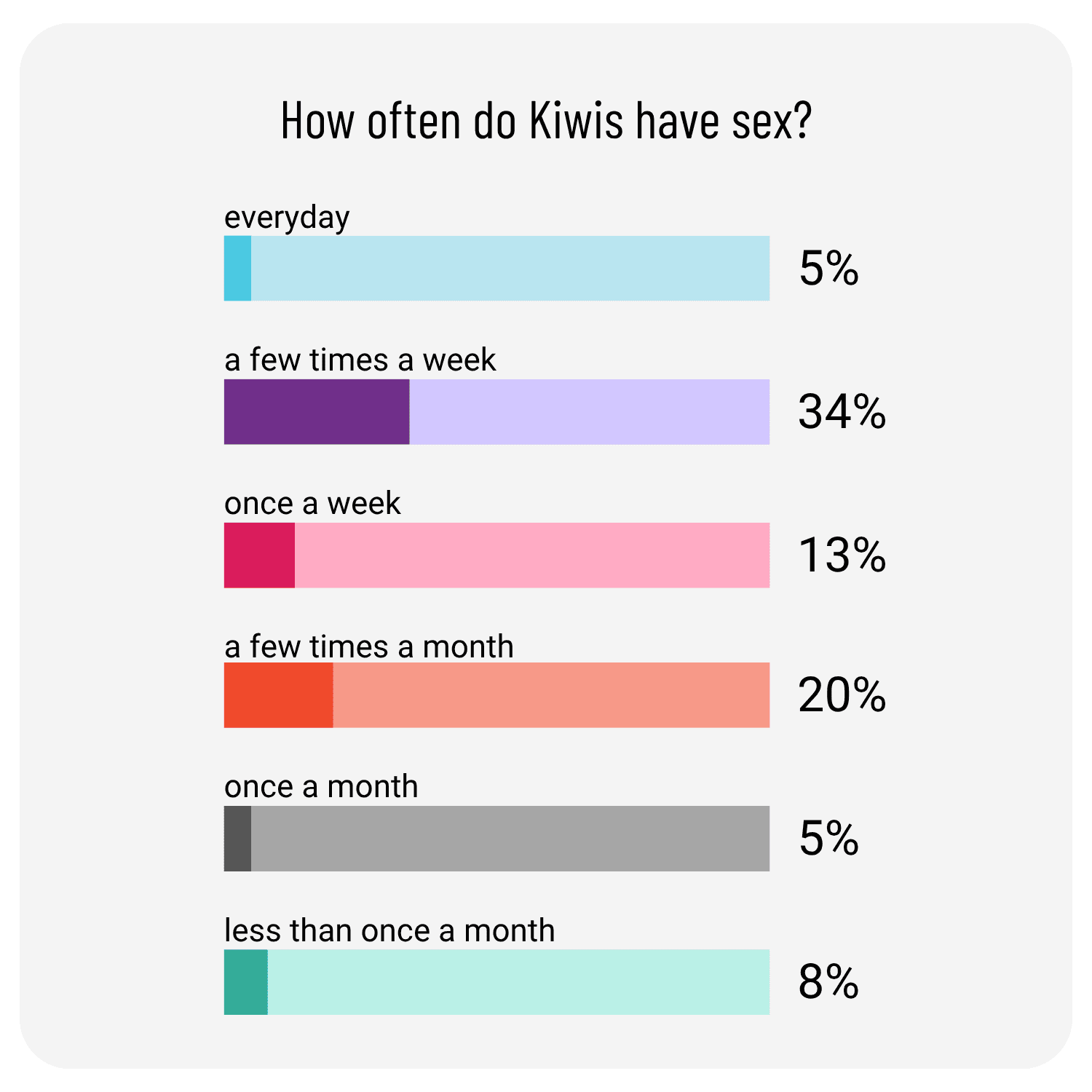
Let’s start with the numbers. How often are Kiwis having sex?
Kiwis are a busy bunch, with over half of those surveyed reporting having sex at least once a week. But is it enough? According to our survey, not quite. There is a significant gap between how often people actually have sex and how often they would ideally like to. Over half (53%) would ideally like sex a few times a week, but only 34% currently experience this. Nearly 29% want sex every day, while just 5% actually have it that often. Conversely, less frequent sex (once a month or less) is much more common in reality than desired. Overall, most of us would like sex to be a bit more frequent.
But surely, it's about quality over quantity? How do Kiwis rate their sexual satisfaction?
For the most part, we’re pretty happy with the sex we are having, and the majority of respondents described themselves as mostly satisfied (42%) or completely satisfied (13%). You go, Glen Coco! However, that still leaves a meaningful portion of people feeling unsatisfied (23%).
We’re having plenty of sex, but does that equate to plenty of orgasms?
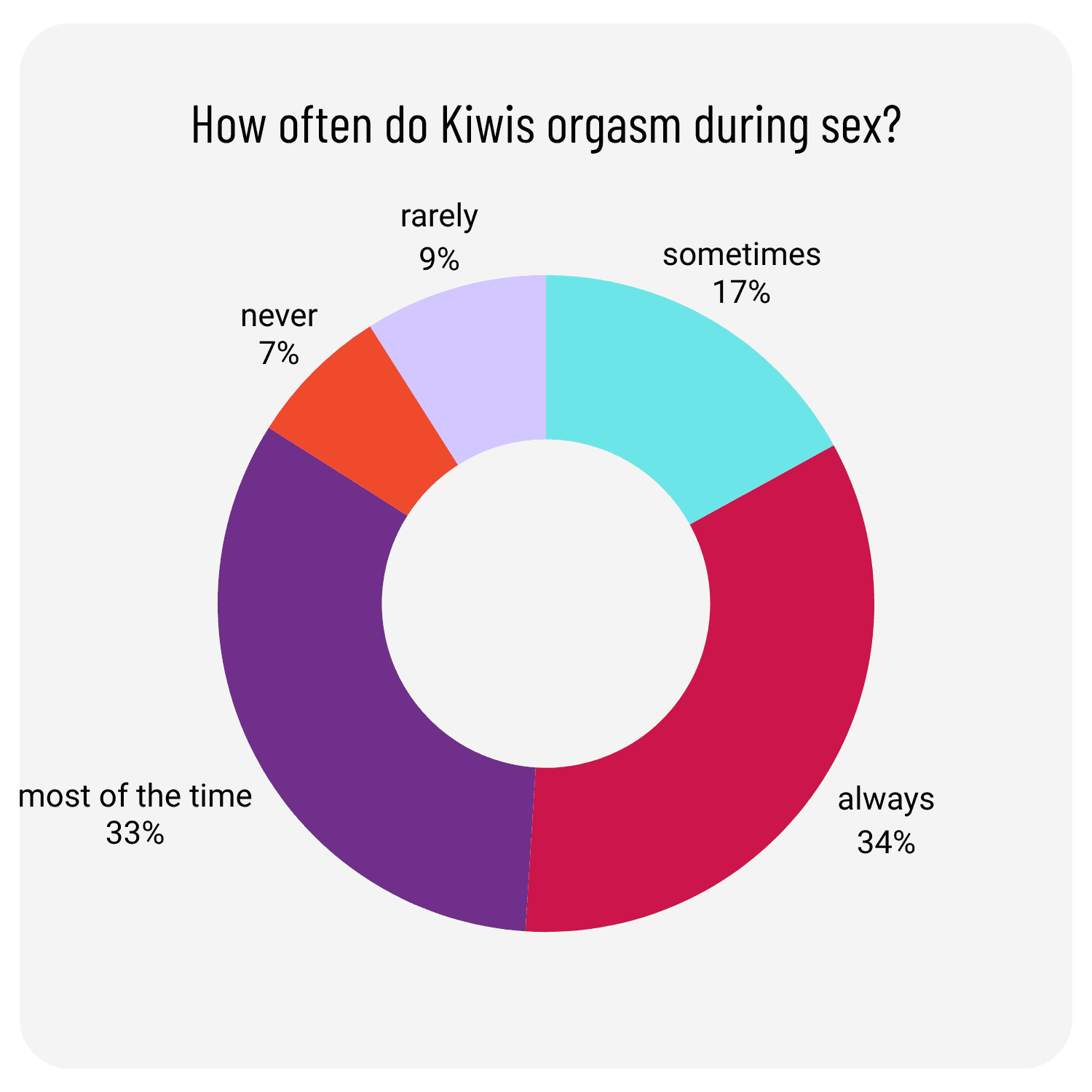
Not necessarily. Only 34% of Kiwis report having an orgasm every time they have sex. 33% orgasm most of the time they have sex, 18% some of the time, 9% orgasm rarely and 7% never orgasm during sex.
Where are we at with the orgasm gap in 2026?
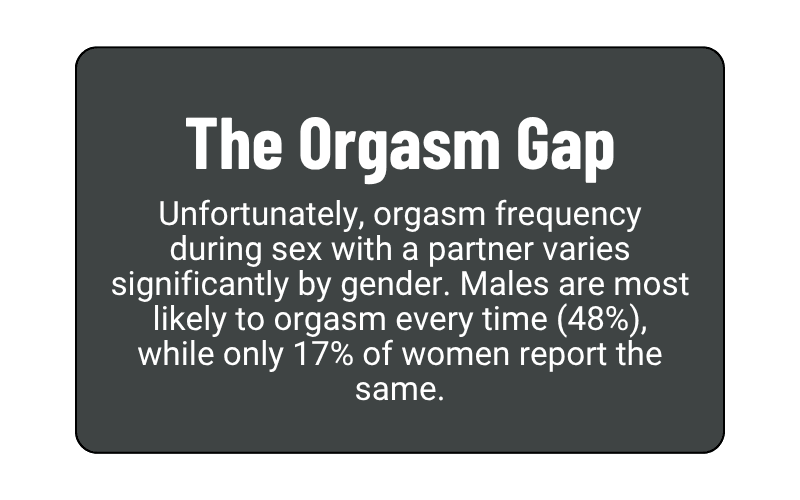
Unfortunately, orgasm frequency during sex with a partner varies significantly by gender. Males are most likely to orgasm every time (48%), while only 17% of women report the same. 29% of women orgasm 'the majority of the time,' but a substantial portion experience orgasms only 'some of the time' (25%), 'rarely' (13%), or 'never' (8%).
The orgasm gap means some Kiwis are left having to fake it...
37% of people have faked an orgasm at some point in their life, and it’s much more common among women than men. A majority of females (58%) report having faked an orgasm at least once, compared to only 15% of males. And the reasons why followed one consistent theme.
Women fake orgasms to end sex without making their partner feel bad.
"I could tell he was trying so hard so I just faked one."
"Sometimes, it’s just easier, than to explain."
"Felt embarrassed that it was taking too long for me to orgasm, so wanted to just get it over with."
The definitive list of New Zealand’s favourite sex positions.
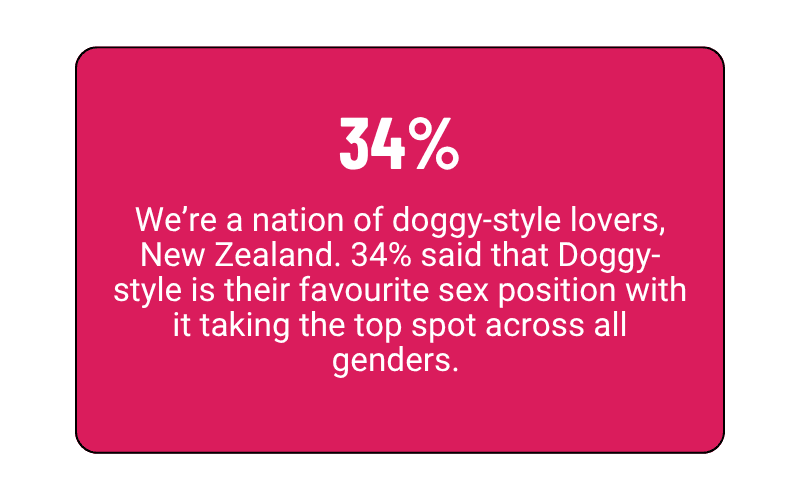
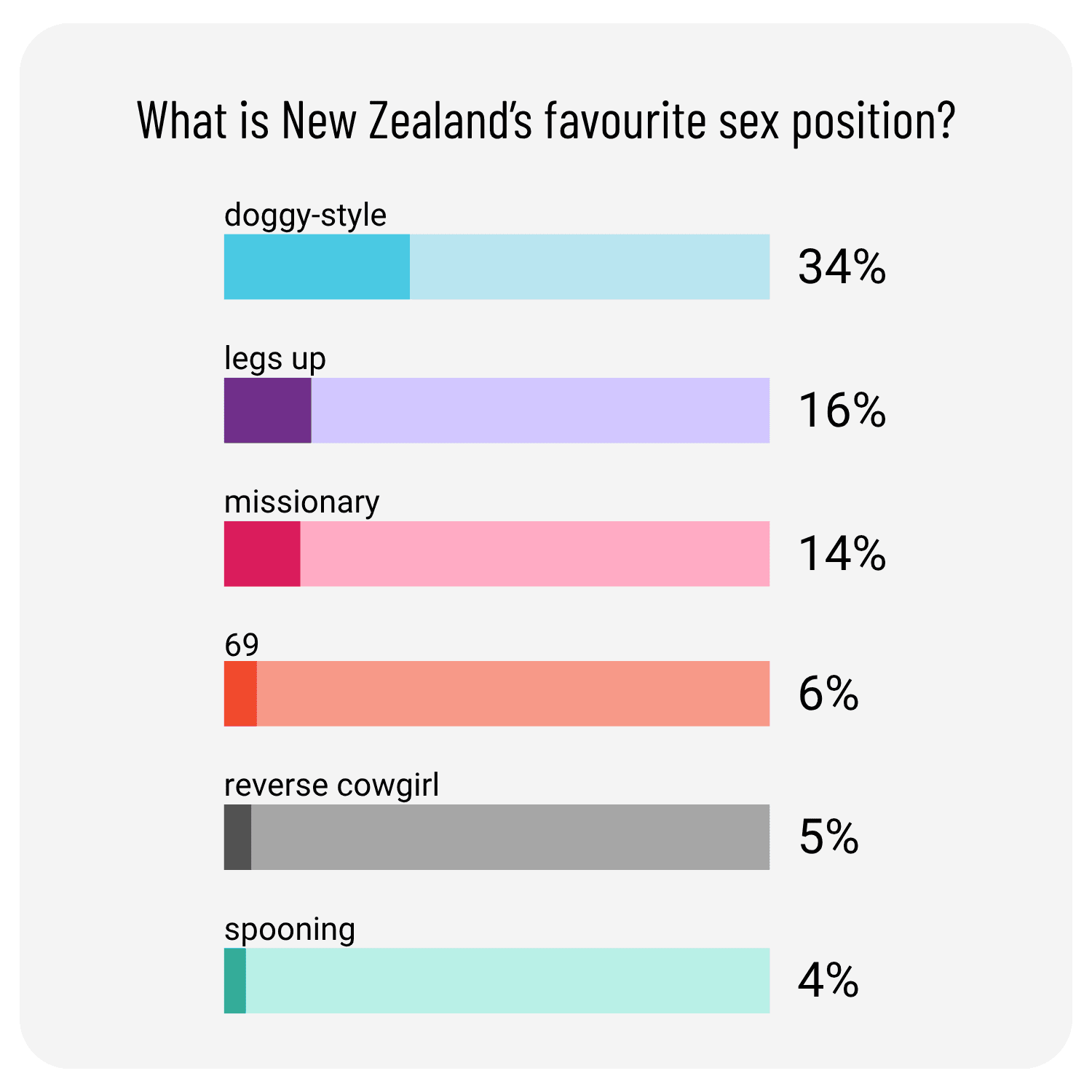
We’re a nation of doggy-style lovers, New Zealand. 34% said that Doggy-style is their favourite sex position, with it taking the top spot across all genders. And it's especially popular for women, with 69% (nice) saying it’s their favourite. Legs up was the second most popular (16%), closely followed by Missionary (14%). The least popular were Standing (1%) and the Lotus (0.5%).
There’s a clear difference between people’s favourite sex positions and the ones they do most often.
While Doggy-style is the most popular favourite, it’s Missionary that Kiwis are doing the most with 40% reporting it as their most common sex position. Other positions like Legs up and Cowgirl/cowboy/cowthey are more often favourites than most common, suggesting people may not always get to do their preferred positions as often as they’d like.
We know how Kiwis are doing it, but how long are they doing it for?
When asked how long an average sex session lasted (including foreplay), the most common answer was 15 – 30 minutes (34%), followed by 30 – 45 minutes (22%). 9% are having a good time for a long time, reporting their average sessions to last over an hour, while 4% are keeping things short and sweet in under 5 minutes.
What are the biggest barriers preventing people from having sex?
In a busy world, 5 minutes of pleasure might be all that some of us have time for, as 20% of those surveyed say that not having time prevents them from having sex. Energy levels and stress were other common barriers, with a massive 46% of respondents saying that low energy levels reduced the amount of sex they were having. Outside of lifestyle impacts, people reported a lack of connection (19%), no interest in sex (10%), a lack of pleasure (5%), and sexual pain (6%) as barriers to sex.
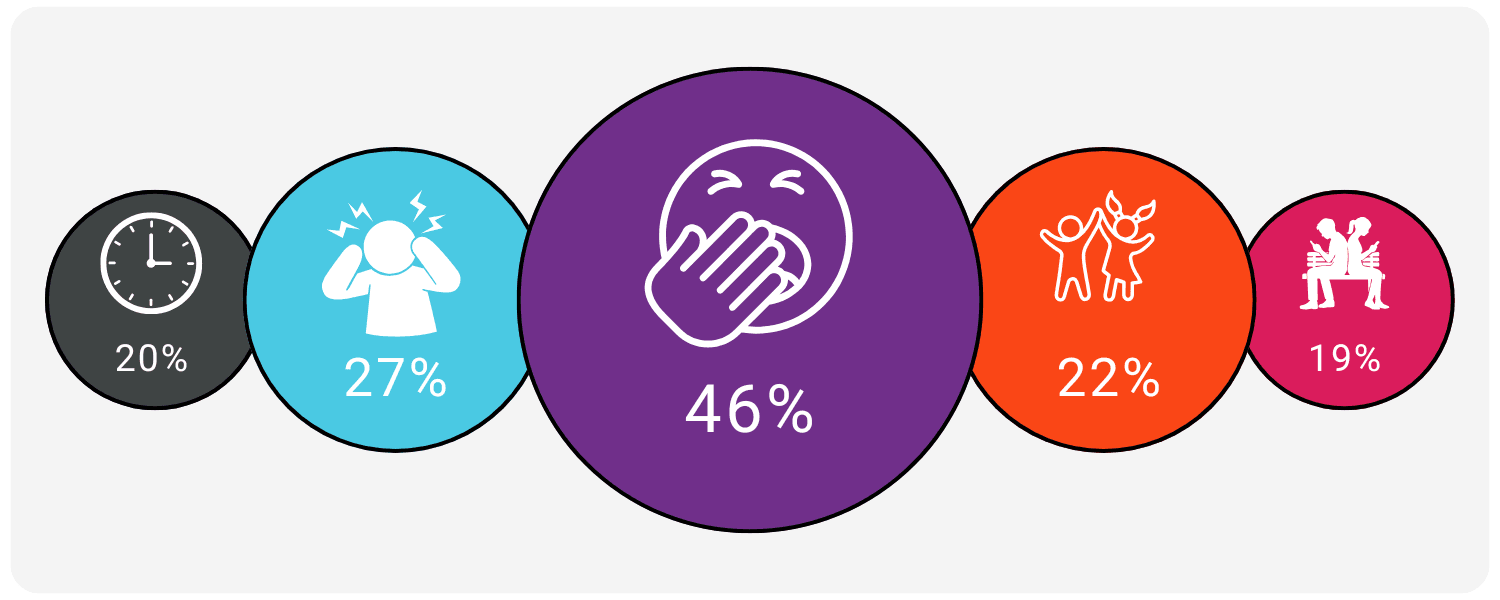
- 46% reported Low energy
- 27% reported stress from work
- 22% reported stress from having kids
- 20% reported having no time
- 19% reported a lack of connection
- 16% reported stress about money
- 6% reported sexual pain
- 5% reported a lack of pleasure
- 2% reported not having a regular sexual partner
With that in mind, what would make sex better?
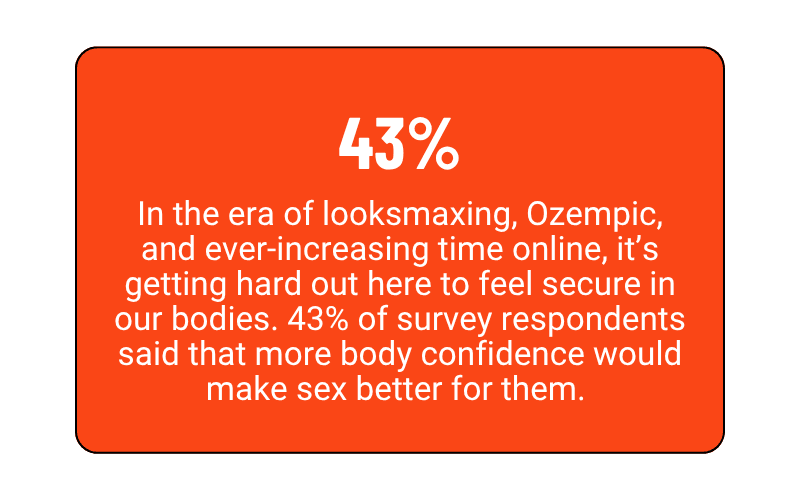
In the era of looksmaxing, Ozempic, and ever-increasing time online, it’s getting hard out here to feel secure in our bodies. 43% of survey respondents said that more body confidence would make sex better for them. And this percentage was significantly higher for women (57%) and gender-diverse folks (58%), and especially for transgender women (63%) who may experience gender dysphoria.
Better sexual skills and sexual exploration were also popular solutions. 29% of respondents said that more confidence in their sexual skills would make sex better, while 24% said that their partner having more sexual skills would help, and 23% wanted their partner to focus more on their needs.
More sexual exploration was also a common desire. 39% of people wanted to try new things, and 35% said that using sex toys more would make sex better. ATMS is here to help if this is you 😏
- 45% say having more sex
- 43% say more body confidence
- 43% say having more energy
- 39% say trying new things
- 37% say having more time
- 35% say using more sex toys
- 29% say having more confidence in their sexual skills
- 24% say their partner having more sexual skills
- 23% say having their partner focus more on their needs
- 19% say increased communication about sex with their partner
- 9% say moving beyond sexual trauma
- 9% say more attraction to their sexual partner
- 7% say reduction of pain for themselves
- 4% say reduction of pain for their partner
02. Dating & Relationships
The dating landscape has changed a lot over the last decade, and it’s all to do with technology. These days, you don’t need to leave the house to meet someone and set up a date; all you need is a smartphone. And it seems that Kiwis are into it, especially the younger ones. 40% of respondents use dating apps to meet new sexual partners, with 24 – 28-year-olds being the most likely to do so (54%), and the 70+ group (unsurprisingly) being the least likely (15%).
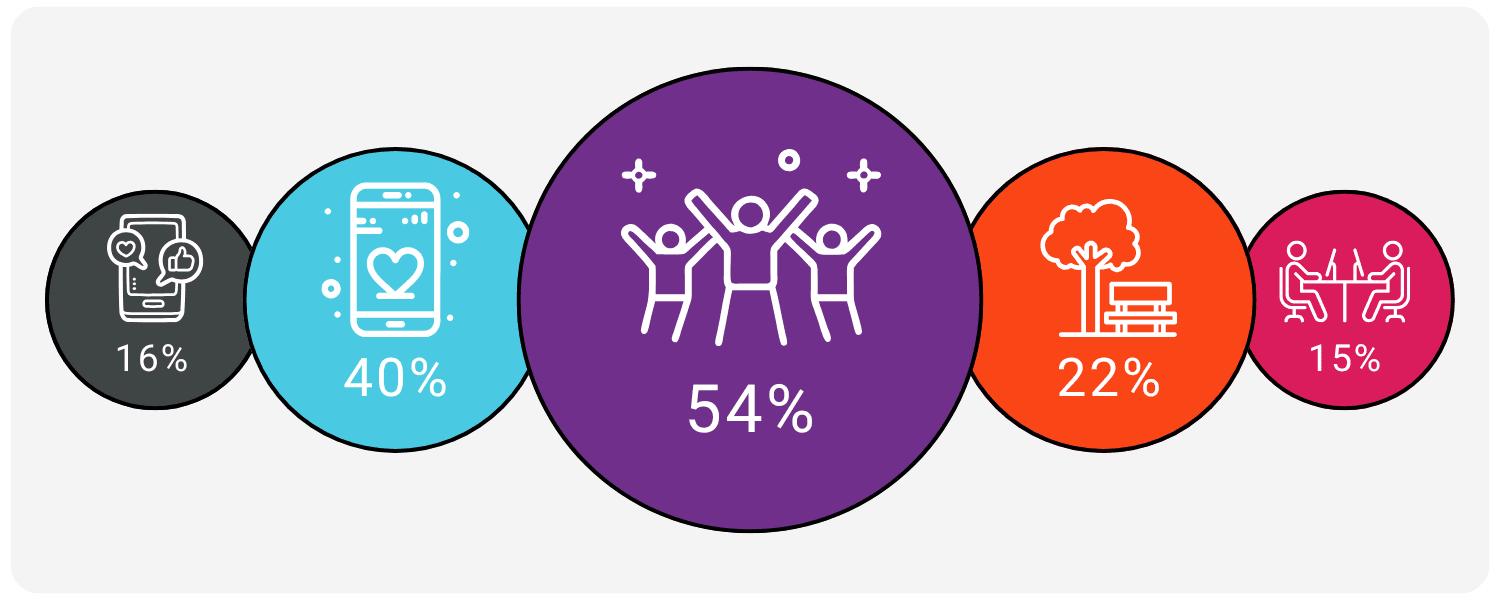
While dating apps might make finding a date easier for young people, they were also the most likely to report finding dating difficult (60%). And of that group, 60% said that meeting new people made them feel anxious. The good news is that dating anxiety lessens with age.
While digital dating is increasingly popular, it only takes the number 2 spot for the most common way that people meet sexual partners. The most common way is through mutual friends (54%), proving that getting out and socialising in person is still the best option if you are looking for love or sex.
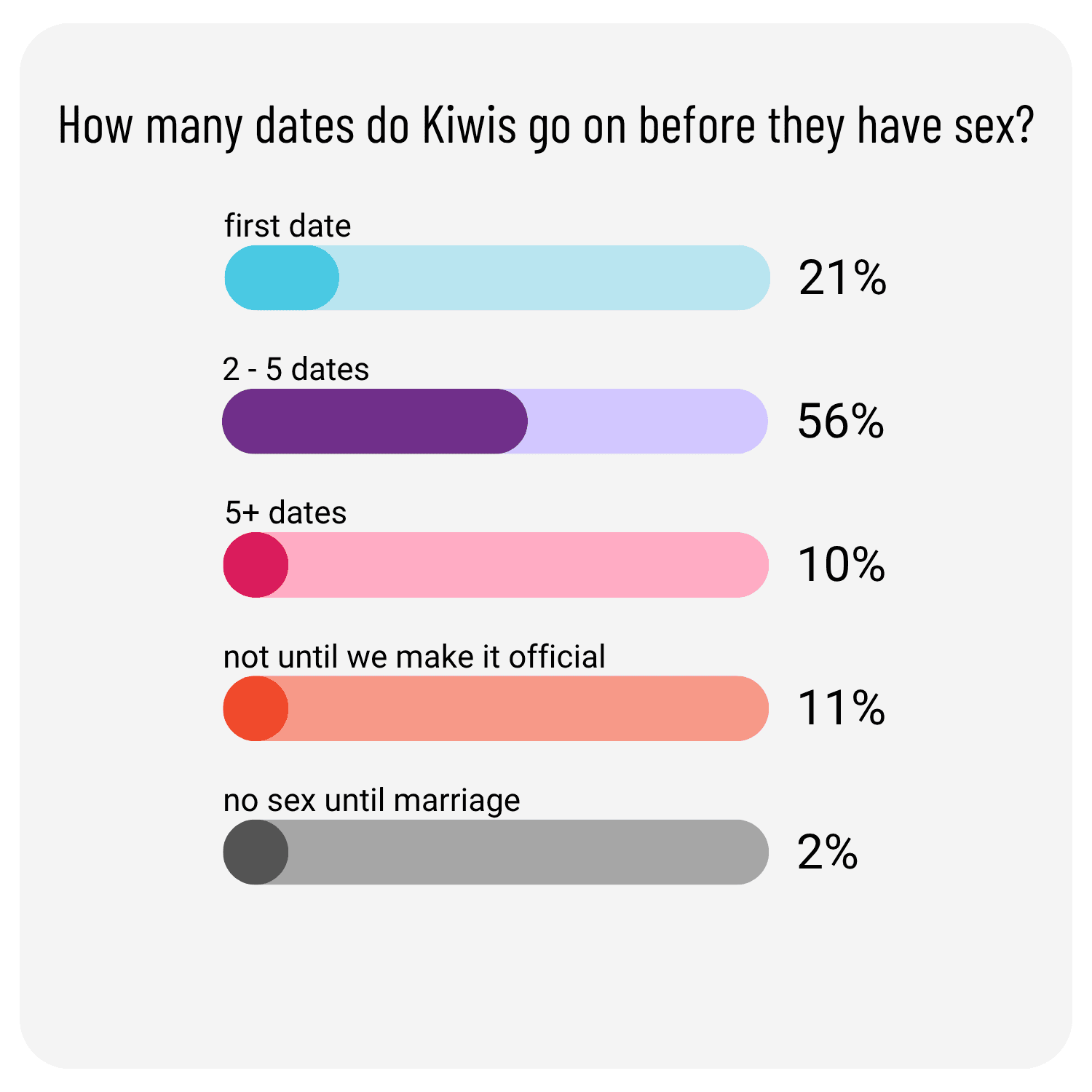
So, the date went well? How many dates does it take before Kiwis sleep with someone new?
The most common response was 2 – 5 dates before sleeping with someone new, with 56% of Kiwis reporting this. This was the most common answer across all age groups. But lots of us are doing it on the first date, too.
21% report having sex on the first date or the first time meeting a person (no date required). 24 – 28-year-olds were the most likely to have sex on the first date, with a ¼ of them doing so. In contrast, those over 70 were the least likely, with 17%.
Interestingly, while young people were more likely to have sex on the first date, 18 – 23-year-olds were also the most likely age to not have sex until they were in an official relationship (27%).
How many people have New Zealanders had sex with?
When it comes to how many people Kiwis have slept with, the numbers are pretty broad.
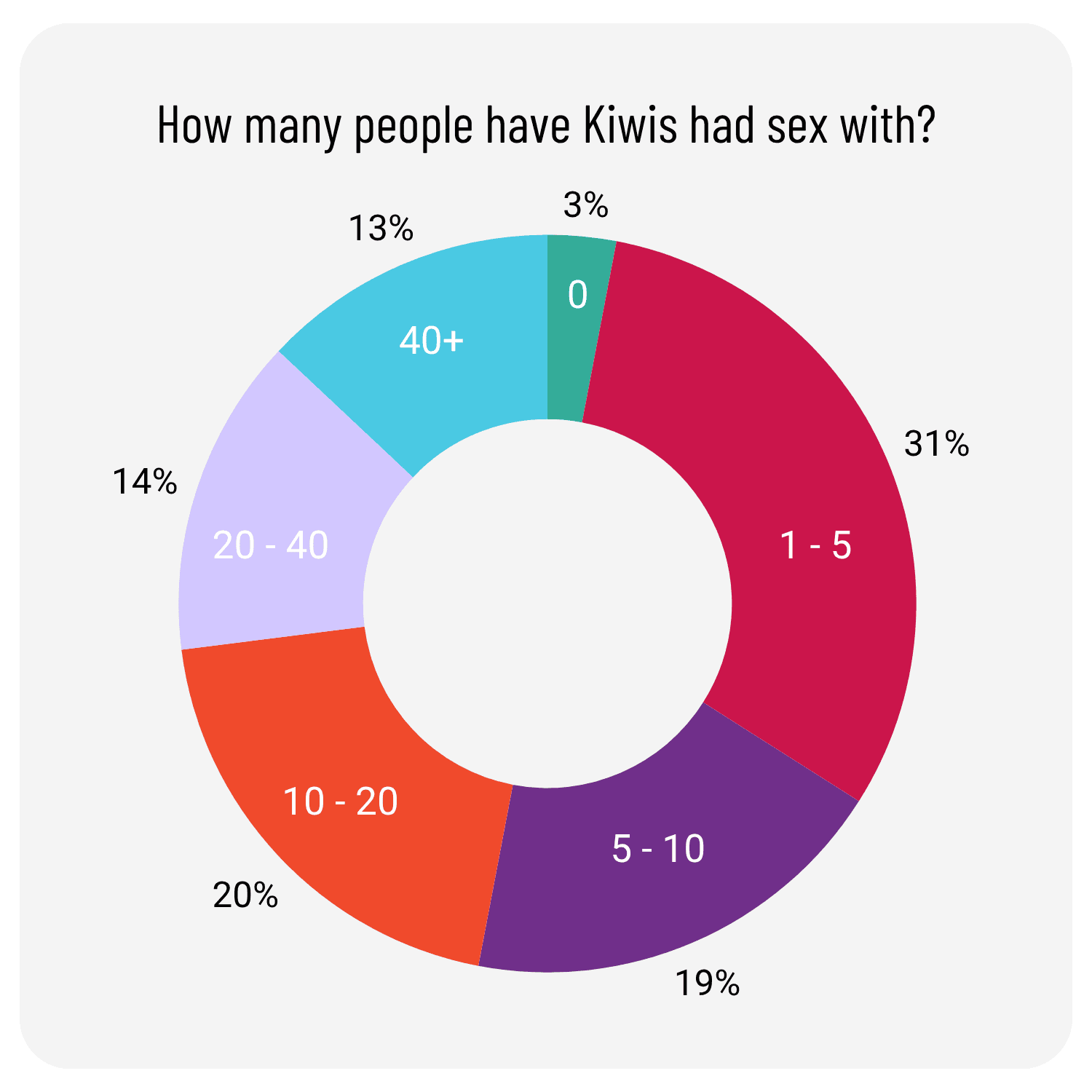
50% of respondents have slept with less than 10 people, with the most common response being 1 – 5 people (31%). 3% report having not slept with anyone, and the remaining 47% have slept with more than 10 people. 9% of respondents are really getting down and have slept with more than 50 people.
Does the number matter to Kiwis?
For most of us, the answer is no. 83% of participants say that they don’t care about the number of people their partner has slept with. However, that leaves 17% that do, and men were slightly more likely to care about their partner's number. 19% of men said they do, compared to 15% of women.
Social messaging is clearly still making an impact. Purity culture, misogyny and conservative ideals all place unrealistic pressure and shame on women for sex outside of marriage. And the numbers reflect this. 20% of respondents have lied to a partner about the number of people they’ve slept with. 3% made the number higher, and 17% made their number lower.
Both men and women were more likely to make their number lower than higher, and women (22%) were more likely than men (12%) to do so.
We know how often Kiwis are having sex, so let's see WHO they are having sex with.
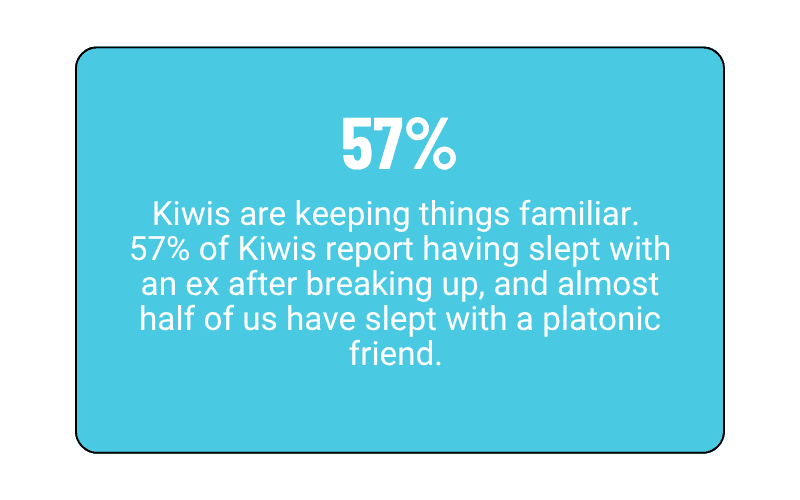
We know that Kiwis are happy to sleep with someone they’ve just met (68%) or someone they met online (60%), but they seem to like keeping things familiar too. 57% report having slept with an ex after breaking up, and almost half of us have slept with a platonic friend.
And when it comes to business, we are clearly keeping things ‘business casual’, as 42% of respondents have slept with a colleague. But for most of us, a flatmate is a bit too familiar, with just over a quarter of us getting down with a flatmate.
Is faithfulness under pressure in New Zealand?
It certainly appears that way. Across New Zealand, a whopping 40% of respondents admitted to having cheated on a partner. That’s right, 2 in 5 people. Of those, half say they cheated with a close friend, while a particularly devilish 15% cheated with a partner’s friend or family member.
But it wasn’t all physical.
While 29% of respondents admitted to cheating physically, 22% said they had cheated emotionally. Women and gender-diverse folks were more likely to cheat emotionally.
These infidelity figures act as a timely reminder that relationships are rarely as simple as we’d like them to be.
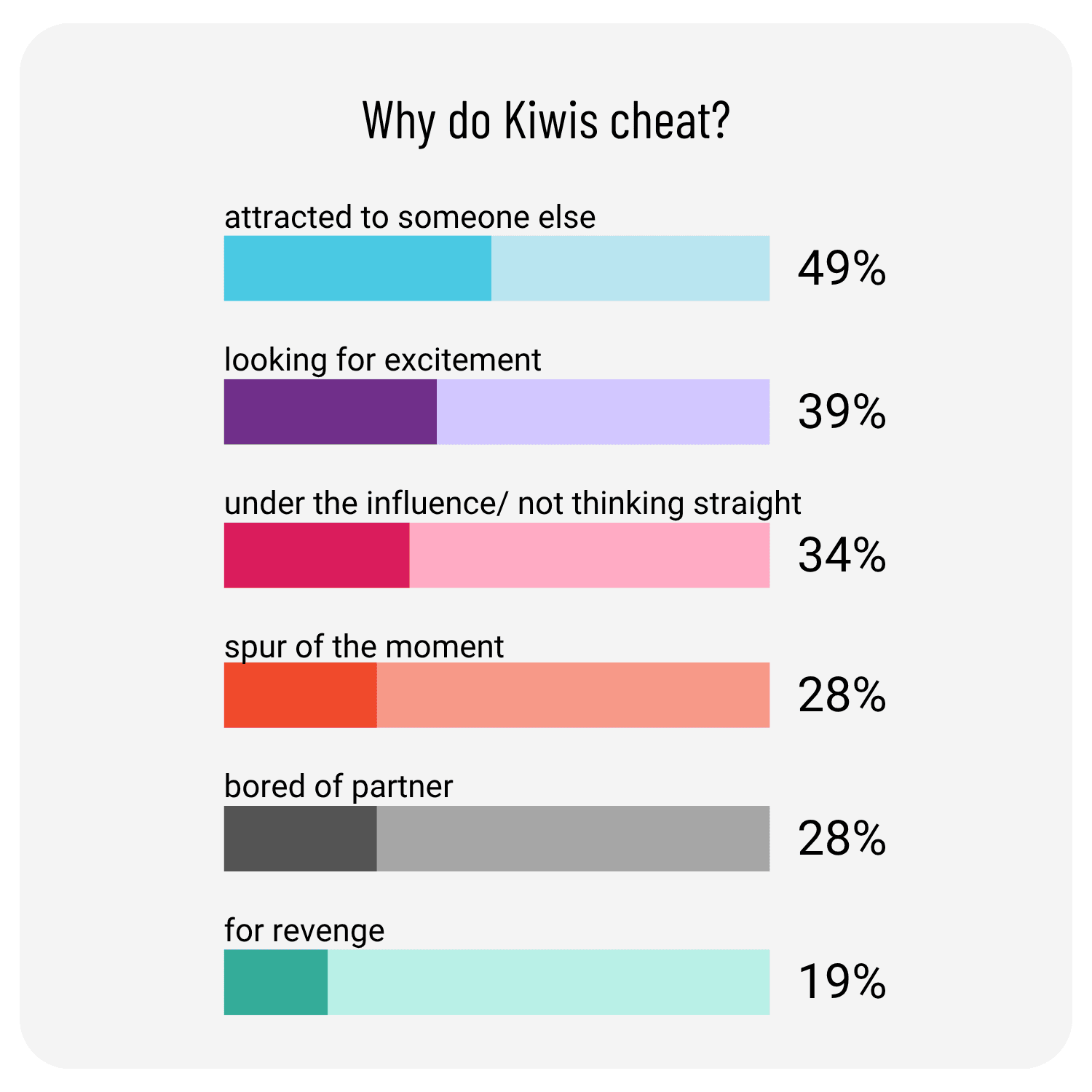
We asked the people who had cheated on their partners why they did it. Here’s what they said.
For most people, excitement and newness were the main reasons for cheating. 49% of respondents said they were attracted to someone else, 39% said they were looking for excitement, and 28% said it was a spur-of-the-moment decision.
Concerningly, 34% of respondents said they were under the influence or not thinking straight, and 19% were doing it for revenge. Yikes.
People seek connection, novelty, and validation outside of their relationship for all sorts of reasons. As our needs and expectations change over time, it’s crucial that couples have honest conversations about what they want from their relationship, and make conscious choices to support that.
Are relationship structures changing in New Zealand?
For some people, those conscious choices look like determining their own relationship structure with their partner, or partners, rather than relying on monogamy as the default. The findings come as conversations around alternative relationship structures become more mainstream, with 18% of participants having tried a form of non-monogamy (such as open relationships, polyamory, swinging). However, 40% of New Zealanders are open to the idea.
We're starting to see some cracks in the traditional idea that marriage is the end goal and should last forever. Monogamy takes work, and the survey suggests Kiwis are taking a new approach and rethinking whether these conventional relationship models actually work for them.
It looks like it’s the LGBTQIA community leading the charge. Queer folks are much more likely to have tried a form of non-monogamy (35%) than heterosexual people (11%). And much more likely to want to try it too. 33% of heterosexual people said they would like to, compared to 54% of LGBTQIA folks.
Surprisingly, Gen Z aren’t as into non-monogamy as you might expect.
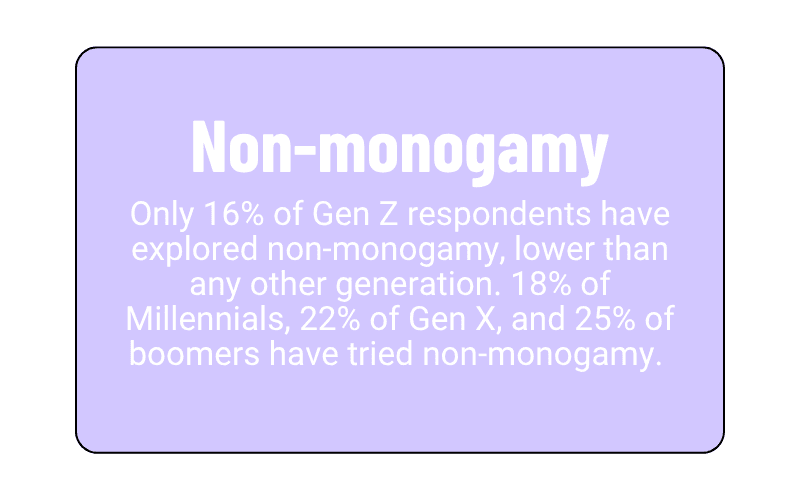
While we seem to be bombarded with media reports characterising Gen Z as the most likely generation to explore non-traditional relationships, our data suggests that this might not be the case. In fact, only 16% of Gen Z respondents have explored non-monogamy, lower than any other generation. 18% of Millennials, 22% of Gen X, and 25% of boomers have tried non-monogamy.
And when it comes to interest in exploring non-monogamy in the future, Gen Z was the least likely to report interest (36%) compared to Gen X, who were the most interested (44%).
And it’s not just our survey that found this. The dating app Feeld partnered with the Kinsey Institute on their State of Dating Report and found that monogamy was the most preferred relationship structure for Gen Z.
This raises the question of why this might be the case. We know that Gen Z is having less sex than older generations, so it could be that they are simply less interested in finding sexual or romantic partners, or they are looking for more traditional (and simple) forms of relationships in uncertain political climates.
There’s also the possibility that monogamy is still the default relationship type, even for young people, and it’s not until people get older, develop more emotionally and look to explore, that non-monogamy becomes more appealing. Our data showing non-monogamous relationship structures becoming more popular with each older generation suggests that this might be the case.
For those wanting to give non-monogamy a go, these were the styles they were most interested in.
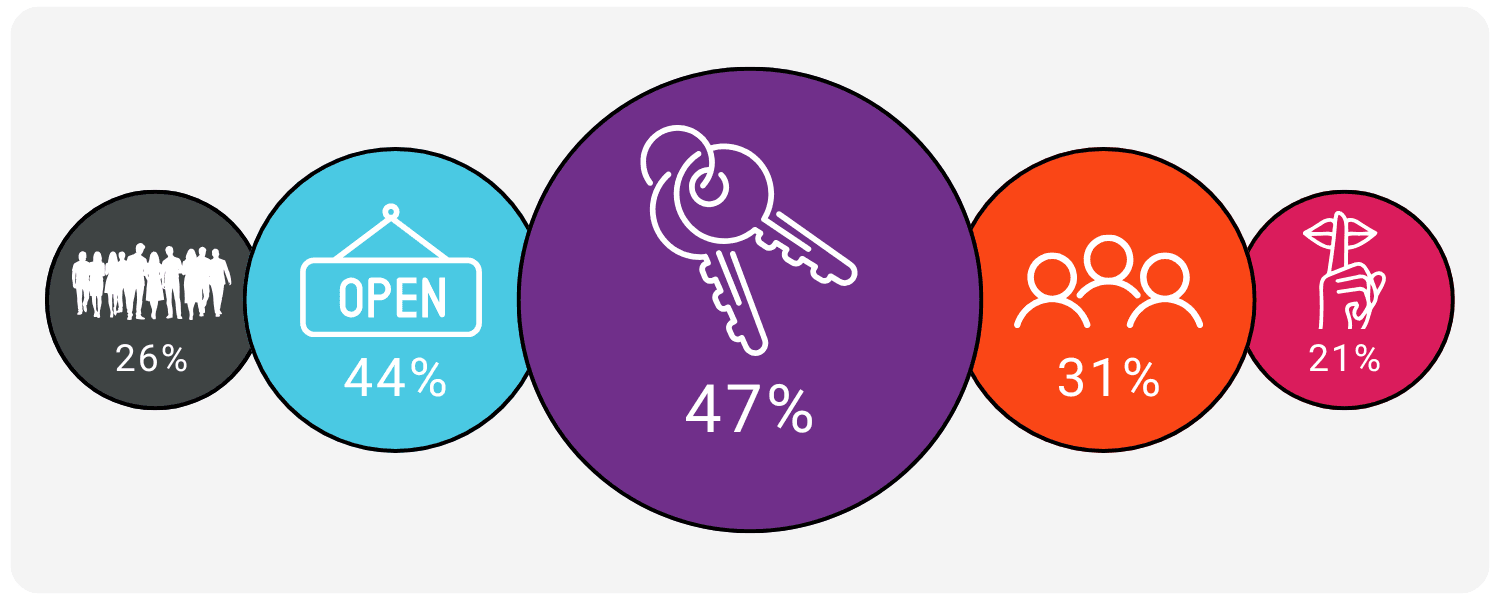
Chuck your keys in the bowl, babe. Swinging is in again. Yes, swinging was the most popular style of non-monogamy, with 47% interested in it. Open relationships came in a close second at 44%, and fittingly, throuples came in third with 31%.
- 47% swinging
- 44% open relationship
- 31% Throuple
- 26% Polyamory
- 21% Don’t ask, don’t tell
- 13% Monogamish
- 5% Hierarchical polyamory
- 5% Relationship anarchy
03. Sex Drive & Libido
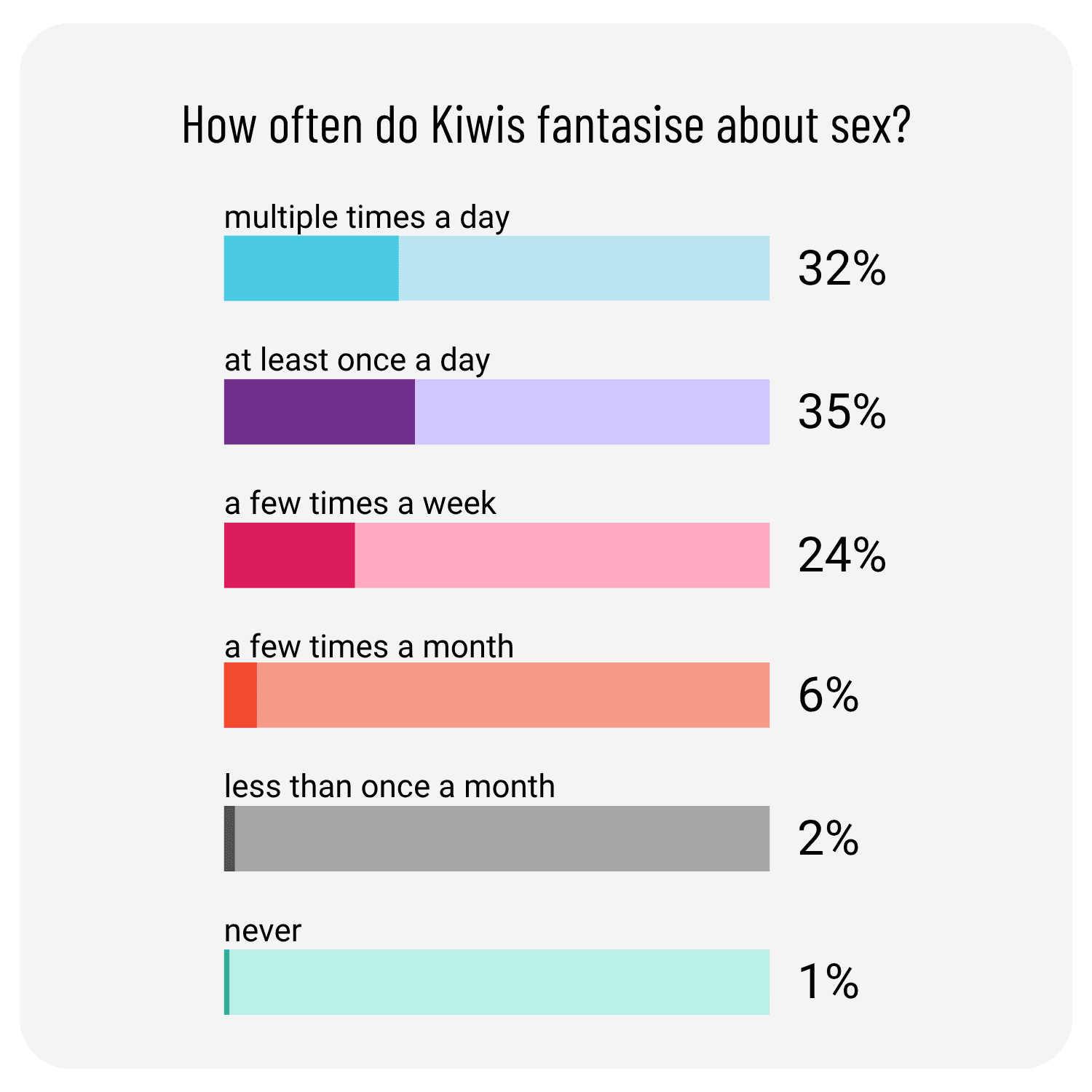
Do Kiwis have sex on the brain? The simple answer is yes. 67% of Kiwis fantasise about sex at least once a day, with just under half of that group dreaming about sex multiple times a day. And men report more frequent sexual fantasising than women, with 80% reporting thinking about sex once or more everyday vs 56% of women.
Are Kiwis a horny bunch?
Libido, sex drive, how horny you are, whatever you want to call it, this is one of the most common topics that sex educators and sexologists are asked about. Libidos fluctuate throughout our lives, but often, when people experience less desire for sex, especially when they are in a relationship, this can become a real stressor for them. So how many people does it affect?
15% of Kiwis reported having a lower sex drive than their partner, while 26% say that they are about the same as their partners. On the other hand, 42% of Kiwis say they have a higher sex drive than their partner, with 58% of men reporting this vs only 28% of women. However, women were more likely than men to think that a difference in sex drives was a problem.
04. Masturbation
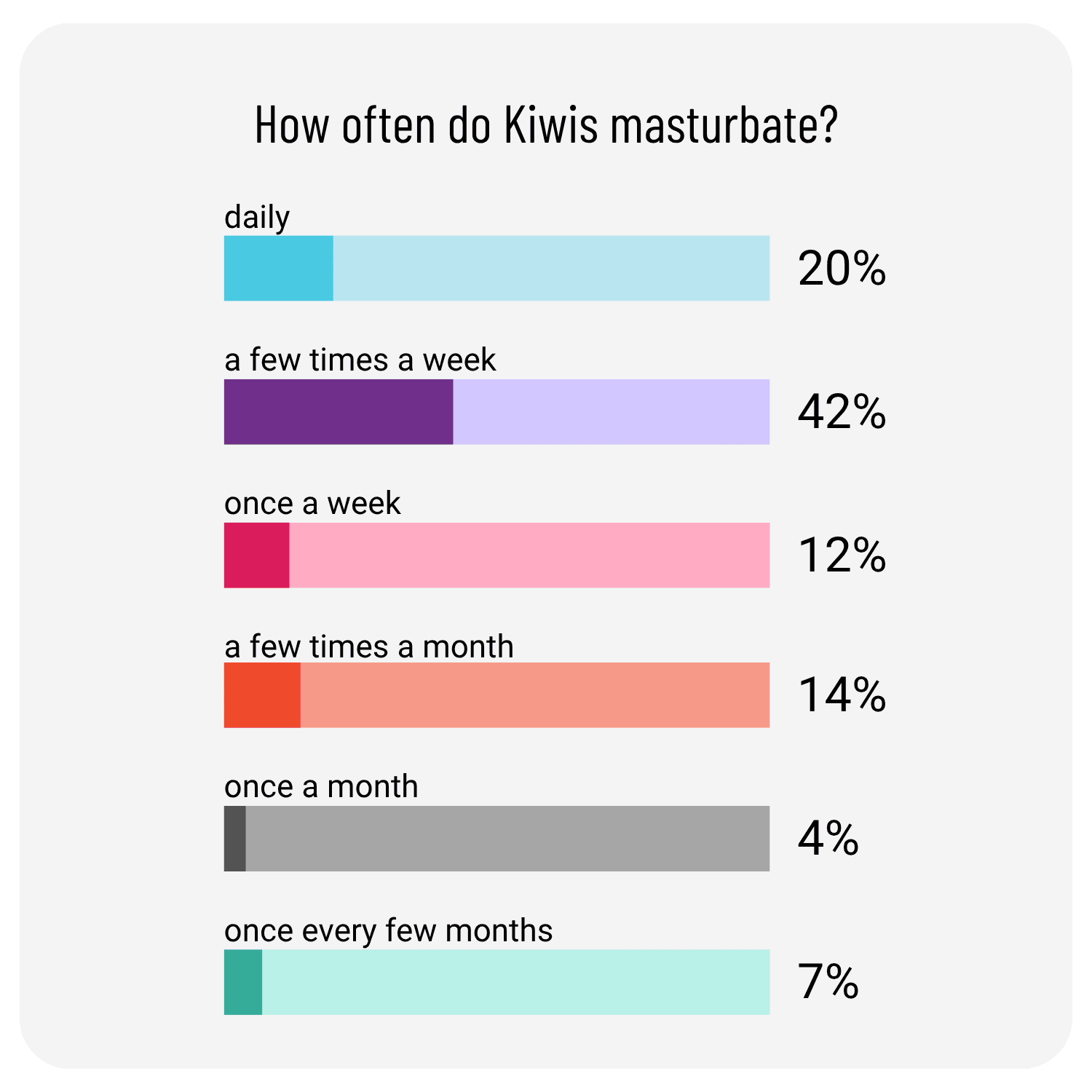
Well, well, well. Give yourself a hand, New Zealand. It looks like Kiwis are definitely into some self-love, with ¾ of us masturbating at least once a week, and 1/5 of Kiwis doing it every day!
Masturbation is good for you. Let New Zealand tell you why.
Masturbation isn’t just a good time; it has lots of proven benefits. 69% of Kiwis report that masturbation helps to reduce stress, while 65% said it helps to improve their mood. And if you are looking to catch more zzz’s, masturbation might be the answer, as 79% of Kiwis say it helps them to sleep better.
But it’s not just good for your mental wellbeing, it’s good for your relationship too, with almost half of Kiwis reporting that masturbation boosts their libido and increases their desire for sex and 30% saying that it increases their sexual satisfaction during play with a partner.
Masturbation has lots of proven health benefits.
- 79% reported better sleep
- 69% reported reduced stress
- 65% reported better mood
- 46% reported increased libido and desire for sex
- 30% reported increased sexual satisfaction during partnered play
- 24% reported relief from bodily pain
- 21% reported more energy
- 20% reported relief from menstrual cramps
How are Kiwis getting turned on?
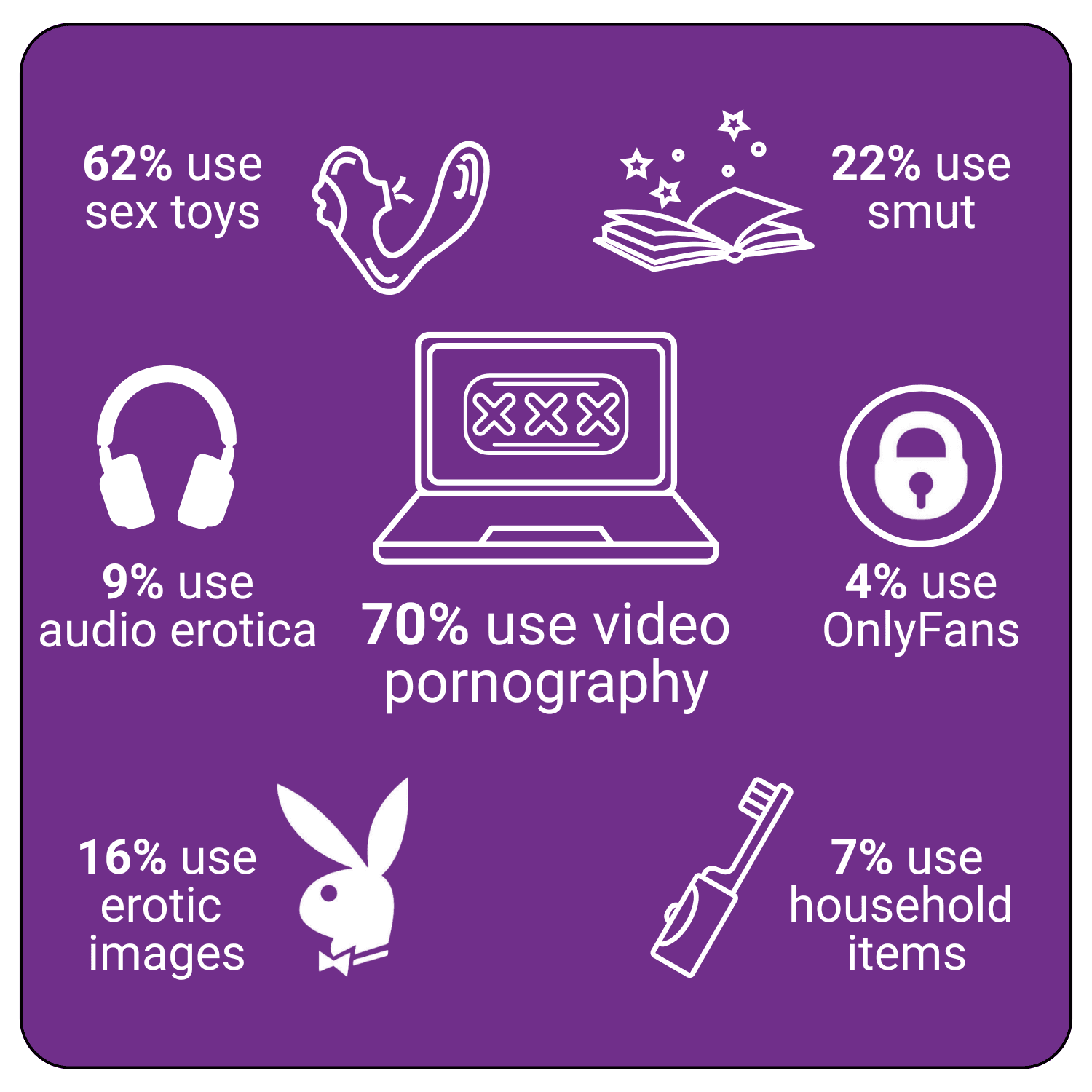
And Kiwis aren’t just using their hands and imaginations. They have plenty of erotic tools at their disposal, and they are putting them to good use. Porn is the most popular tool to increase arousal during masturbation, with 70% of Kiwis using it. Sex toys come in a close second with 62% of Kiwis using them for masturbation. 7% of the country is going old-school with household items like showerheads, toothbrushes and pillows. And only 11% report raw-dogging it, no smut, no tools, just their hands and brains to help them get off.
05. Experimentation & Kinks
Kiwis have a bit of a reputation for being somewhat vanilla in the bedroom… but it looks like we might be a more sexually exciting bunch than we are given credit for.
Here’s how New Zealanders are exploring sex in the bedroom.
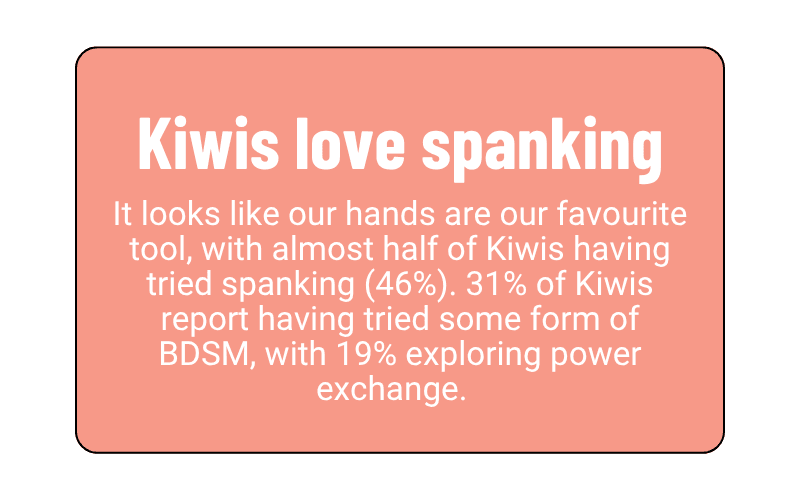
Let’s dip our toes in with a bit of impact play, where it looks like our hands are our favourite tool, with almost half of Kiwis having tried spanking (46%). 31% of Kiwis report having tried some form of BDSM, with 19% exploring power exchange.
A whopping 36% of Kiwis have made a sex tape, suggesting that we like to watch ourselves having sex with others.
We’re also pretty into multi-partner sex. 34% of Kiwis have had a threesome, and 10% have had group sex (more than 3 people at once), and 7% have attended a sex party. And this is what Kiwis are most into, although it looks like actually engaging in these activities might be difficult, as there’s a significant gap between what people have tried and what they want to try.
For most activities—such as attending a sex party, group sex, swinging, pegging, and threesomes — interest in trying them is much higher than experience.
For example, while 34% of Kiwis have had a threesome, 46% want to, and 29% want to attend a sex party, vs only 7% that have. And when it comes to pegging (having anal sex with a strap-on harness), 22% of Kiwis are keen to give it a try, while only 14% have actually done it.
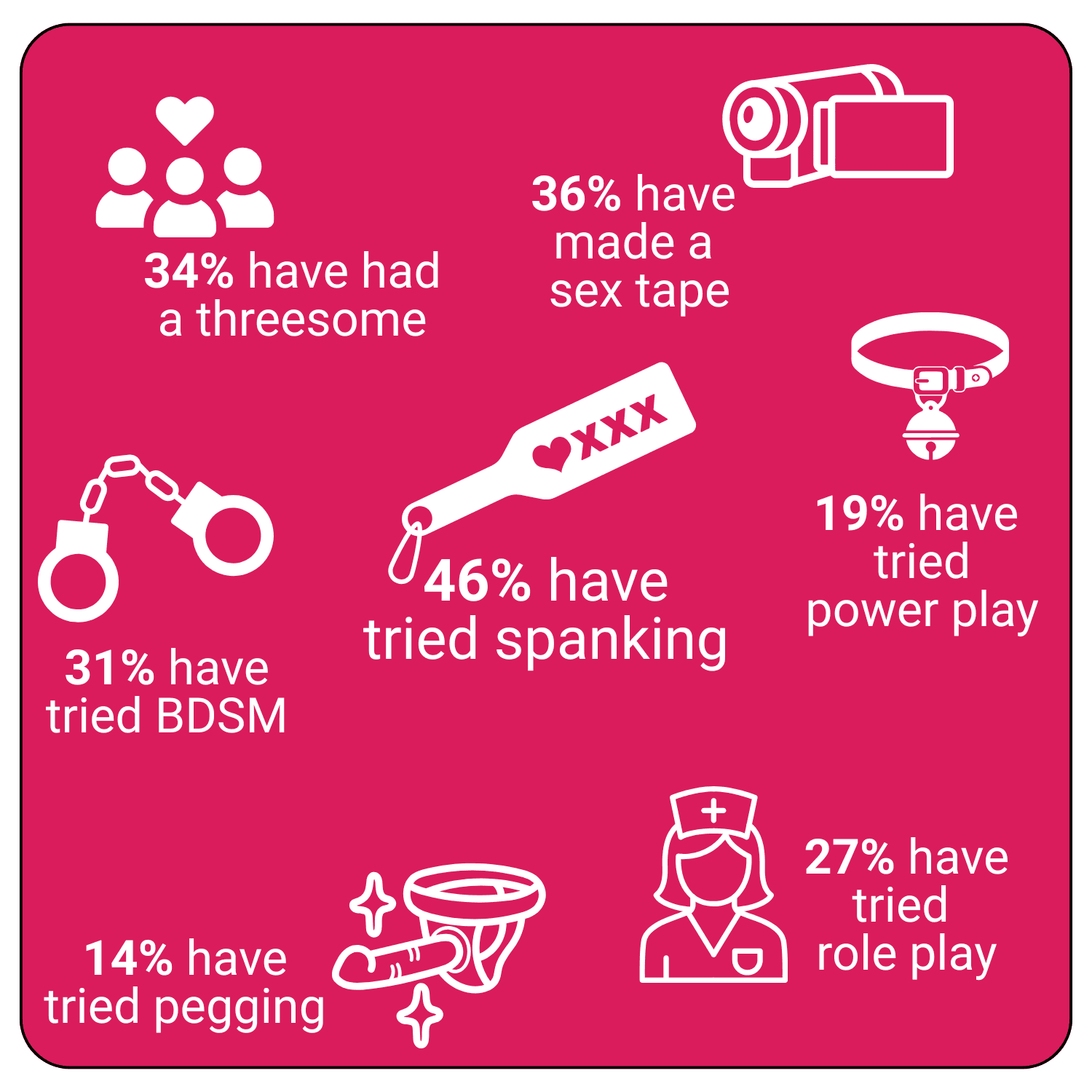
- 46% have tried spanking
- 36% have made a sex tape
- 34% have had a threesome
- 31% have tried BDSM
- 27% have tried role play
- 19% have tried power play/ power exchange
- 14% have tried pegging
- 10% have had group sex
- 7% have attended a sex party
- 7% have tried swinging
So what’s holding people back from sexual exploration?
Well, it looks like there’s still plenty of shame associated with non-vanilla sex that might explain some of the discrepancies in the desired vs actual sex acts we engage in. When asked if Kiwis had ever felt embarrassed or ashamed about any of their kinks, 32% said yes.
In fact, there was even a hesitancy for some to call themselves kinky despite reporting having kinks. Only 17% of Kiwis defined themselves as not being kinky, while 35% said they were. And what about the rest? 48% said that they have a few kinks but don’t identify themselves as kinky.
Whether you consider yourself kinky, vanilla or somewhere in between (it’s a big spectrum), sex is all about pleasure and connection, so do what makes you happy. But don’t forget not to yuck someone else’s yum. Just because you aren’t into it doesn’t mean that you should make others feel ashamed when they are.
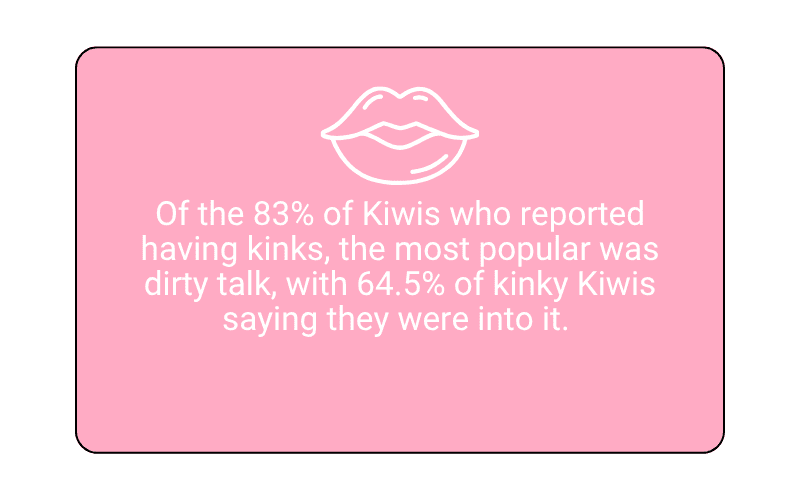
Of the 83% of Kiwis who reported having kinks, the most popular was dirty talk, with 64.5% of kinky Kiwis saying they were into it. The second most popular kink was bondage and restraint play (64%), then orgasm control (50%), and then praise kinks (34%). And hey, you’re doing amazing, sweetie. Conversely, 19% said they had a degradation kink, and twice as many people report enjoying receiving pain (masochism, 24%) as inflicting pain on others (sadism, 12%).
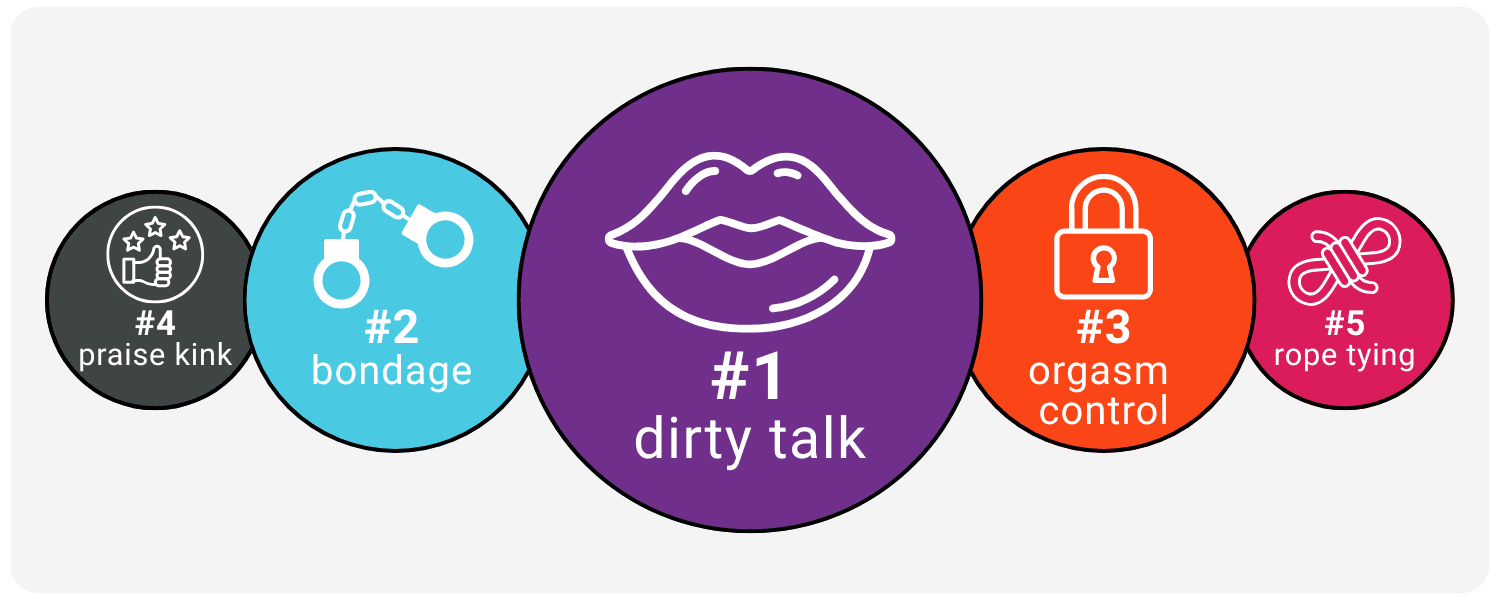
- 64.5% are into dirty talk
- 64% are into bondage/restraints
- 50% are into orgasm control
- 34% have a praise kink
- 34% are into rope tying
- 31% are into exhibitionism (being watched)
- 30% are into voyeurism (watching)
- 24% are into masochism (enjoyment from experiencing pain)
- 22% are into gags
- 20% are into impact play
- 19% have a degradation kink
- 17% are into golden showers
- 14% are into humiliation
- 14% are into cuckolding
- 12% are into sadism (enjoyment from causing pain)
- 12% are into rubber/latex
- 8% have a foot fetish
- 3% are into financial domination
We know what Kiwis are getting up to bed, but what’s going on inside their heads?
Despite how we actually engage with others sexually, sexual fantasies are a fun way to get turned on and add some spicy energy to your day. These are the most popular sexual fantasies that Kiwis fantasise about, regardless of whether they actually want to try them.
- 57% fantasise about being dominated
- 55% fantasise about having sex in an unusual location
- 52% fantasise about being restrained
- 50% fantasise about having rough sex
- 49% fantasise about having sex in public
- 43% fantasise about multipartner sex
- 35% fantasise about role play
- 34% fantasise about restraining someone else
- 33% fantasise about dominating someone else
- 32% fantasise about exhibitionism (being watched)
- 29% fantasise about voyeurism (being watched)
- 29% fantasise about group sex
- 27% fantasise about sex with a stranger
- 24% fantasise about sex with a celebrity
- 15% fantasise about cuckolding
- 11% fantasise about gender swapping
- 8% fantasise about infidelity
06. Sex Toys
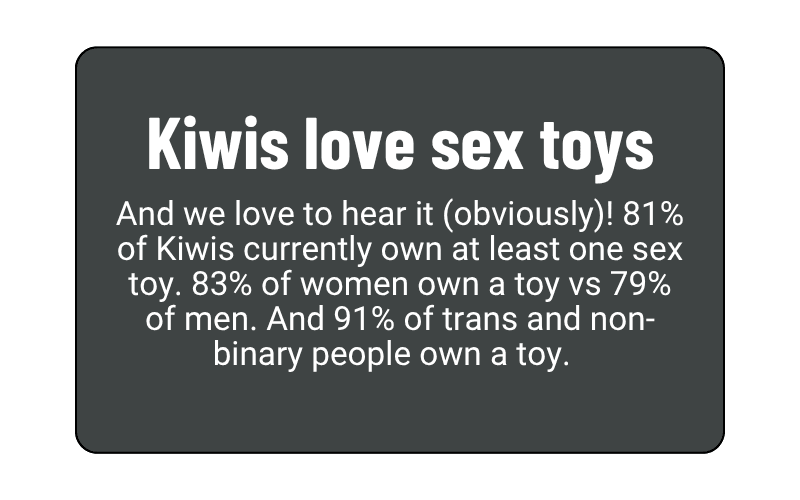
Kiwis certainly love their sex toys, and we love to hear it (obviously)! 81% of Kiwis currently own at least one sex toy, with 9% not currently owning any but having done so in the past, and 9% never owning a sex toy. And, contrary to what you might expect, there’s not much of a difference in toy ownership across gender. Yes, women are more likely to own a sex toy than men, but only just. 83% of women own a toy vs 79% of men. And 91% of trans and non-binary people own a toy.
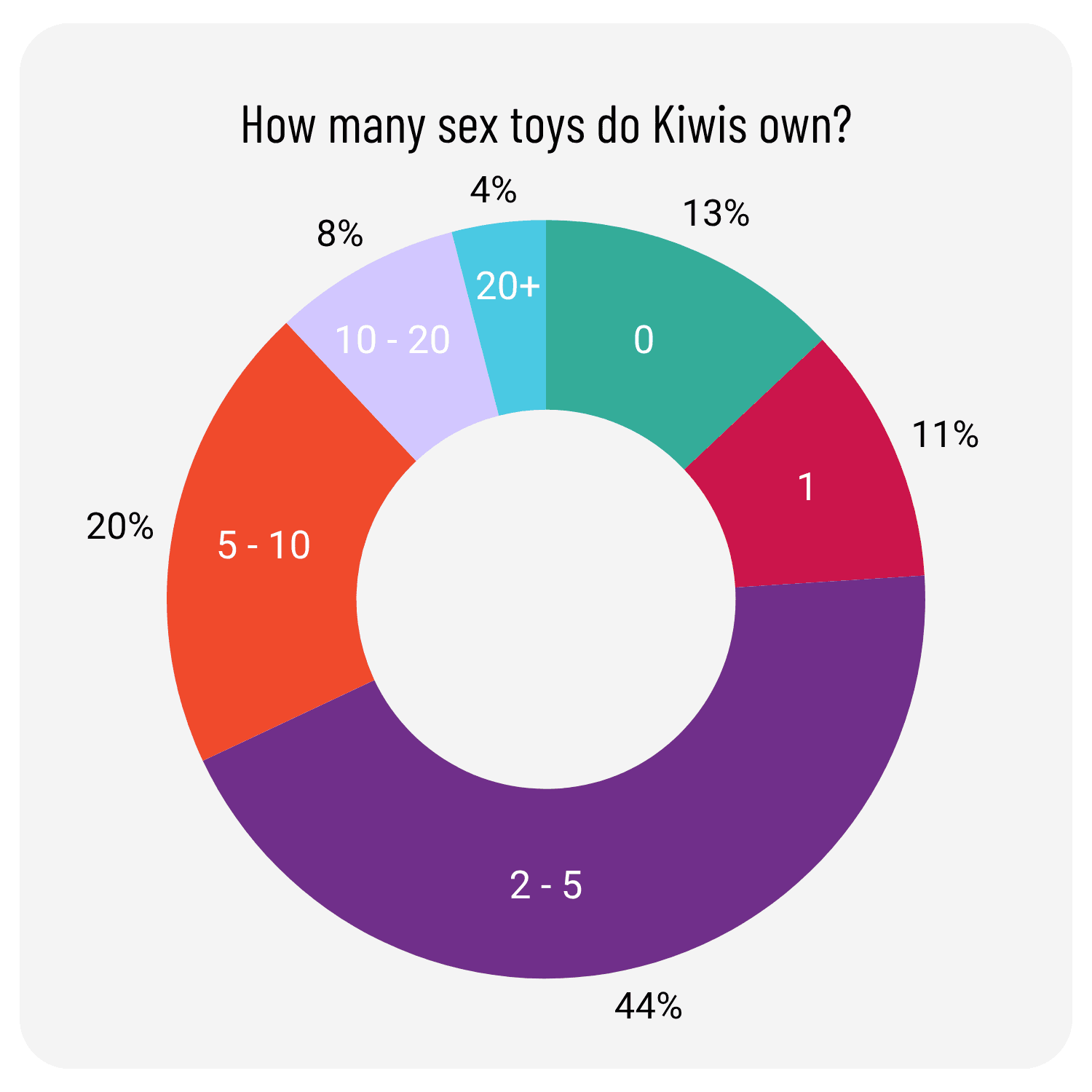
When it comes to sex toys, it’s not just one and done for Kiwis. 44% of us own 2 – 5 toys, and 20% own 6 – 10. And 4% of Kiwis are serious sex toy collectors with over 20! That’s going to require a big toy box.
What’s the most popular sex toy in New Zealand? This one might surprise you.
The humble dildo reigns supreme as the sex toy that most people have tried, with 63% of Kiwis having used one. While maybe not the most exciting toy in the world, the dildo clearly offers mass appeal as it can be used vaginally or anally, meaning that you can use it no matter your anatomy.
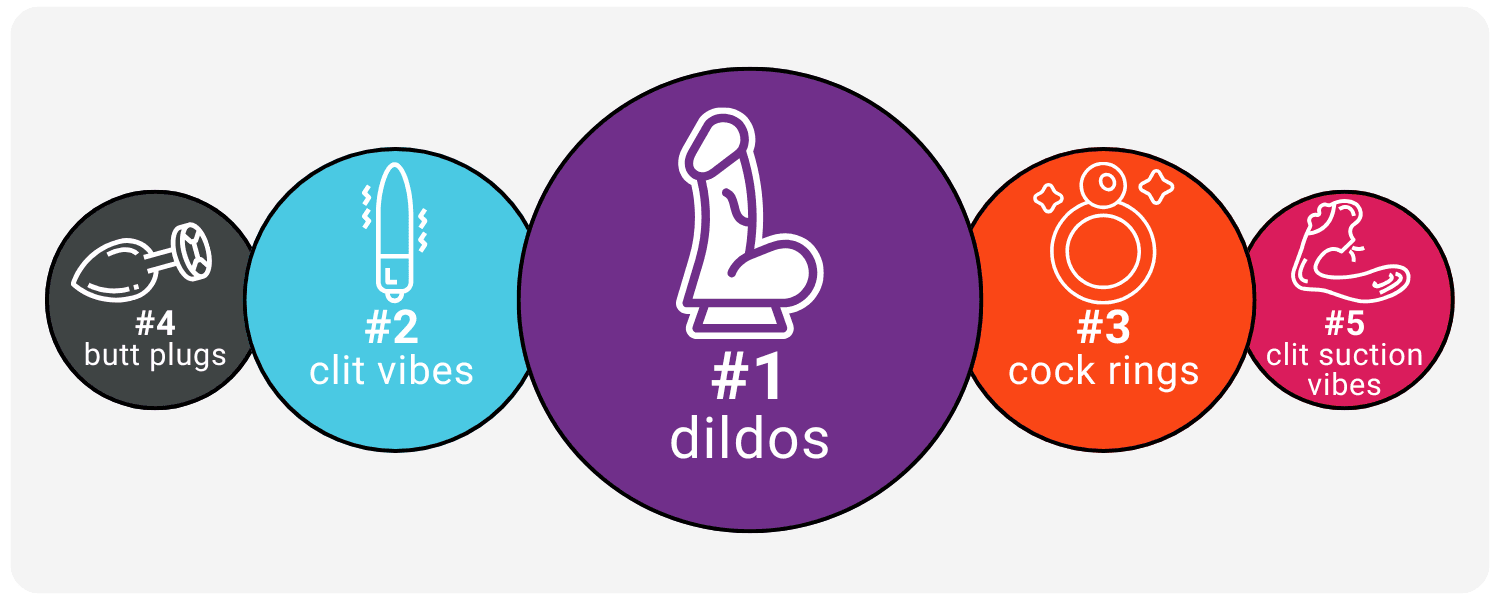
Clitoral vibrators were the second most popular toy, with 53% of Kiwis having tried one, and then cock rings to round out the top 3, with 49%. Butt plugs came in a very close 4th with 48%. Looks like the booty is finally getting the love it deserves! It’s packed with nerve endings and the prostate for folks with a penis, so it has a serious amount of pleasure potential for those willing to explore it.
- 63% have tried a dildo
- 53% have tried a clitoral vibrator
- 49% have tried a cock ring
- 48% have tried a butt plug
- 46% have tried a clitoral suction toy
- 38% have tried an internal G-spot vibrator
- 30% have tried a penis masturbation toy
- 28% have tried BDSM/ bondage gear
- 26% have tried a remote-control vibrator
- 23% have tried anal beads
- 21% have tried a couple's vibrator
- 21% have tried nipple toys
- 17% have tried an app-controlled vibrator
- 10% have tried a penis pump
- 9% have tried sex furniture/ position aids
We know Kiwis are using sex toys, but how often?
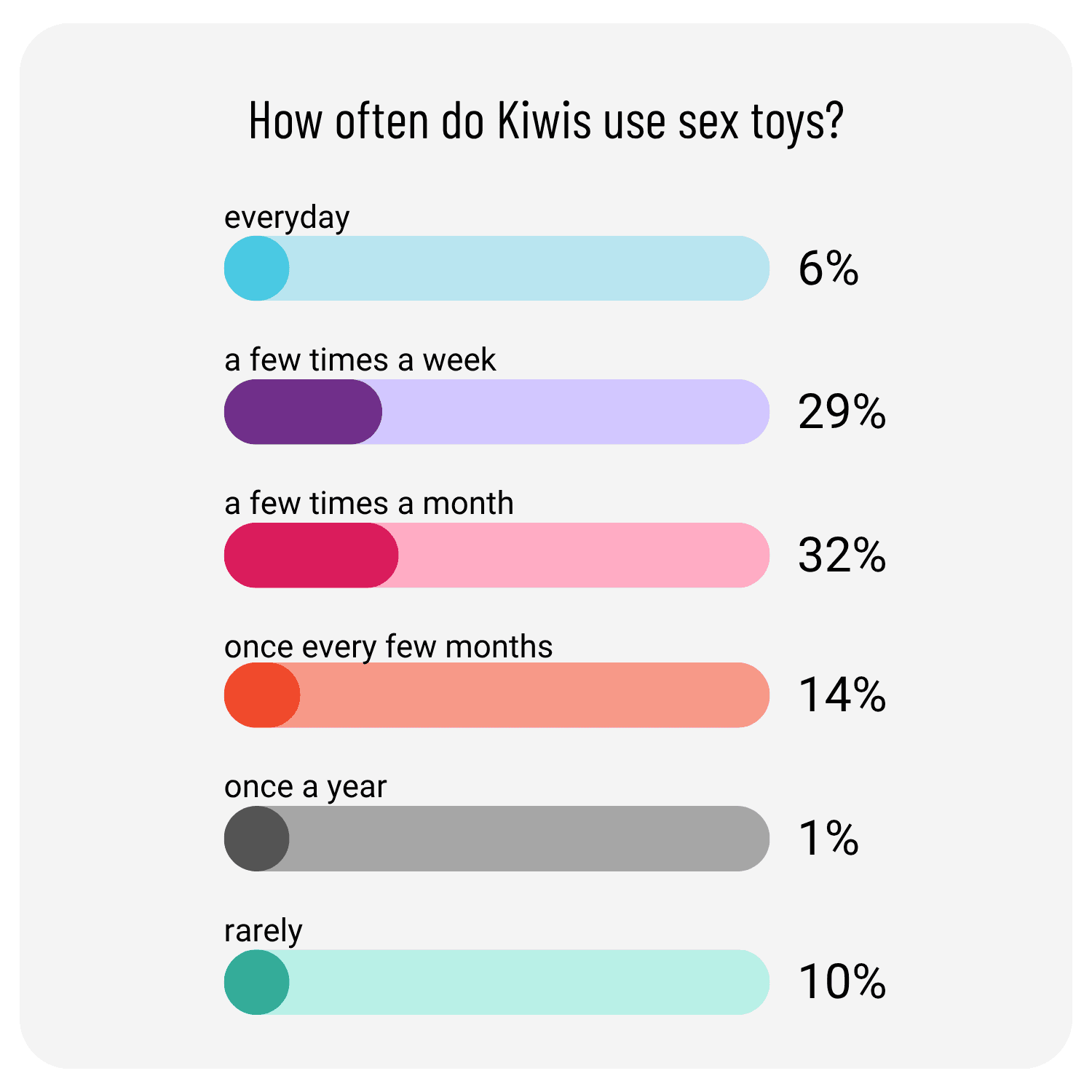
While 6% of the country are going at it with a toy every day (good for you!), the most popular response was a few times a month (32%), followed closely by a few times a week (29%). And women are using them more often than men. 7% of women reported using a sex toy every day vs only 3% of men, and 37% of women report using them a few times a week. Almost 10% higher than the average for weekly use.
And, we aren’t just using them for solo sessions. 81% of Kiwis who have tried a sex toy have used them with a partner at least once, with 8% of Kiwis using a sex toy every time they play with a partner. 20% report using a sex toy with a partner most of the time, and 31% use a toy most of the time.
Married couples are leading the charge with this, with ¼ of them reporting using sex toys with a partner most of the time and 13% always using one.
Sex toys are your team mates, not your competition!
And we have the stats to prove it. When asked about sex toy satisfaction, only 8% said they preferred using a sex toy to a sexual partner. 45% said they prefer a sexual partner, and 47% said they like them both equally and why not?!
Sex toys are designed with only one goal, and that’s pleasure! Using a sex toy adds more stimulation, more excitement and helps people to have more orgasms. They are another tool in your pleasure toolbox, but unfortunately, not everyone sees it that way. Sex toys have been the cause of friction within a relationship for some. 10% of Kiwis reported a past or present partner becoming upset with them using a sex toy, with this bumping up to 15% for women vs only 6% of men having the same experience.
The good news is that 88% of participants said that sex toys have never caused friction in a relationship.
07. Pornography
Like it or not, a lot of Kiwis are watching porn; in fact, nearly all of us are, with 97% reporting watching pornography online at some point. For 9% of us, it’s a daily ritual, and for 42% of us, it’s a weekly one.
Men are watching it more frequently than women. 15% of men view it every day, vs only 3% of women. And 45% of men view it a few times a week, vs 21% of women. Only 6% of participants say they don’t watch it at all.
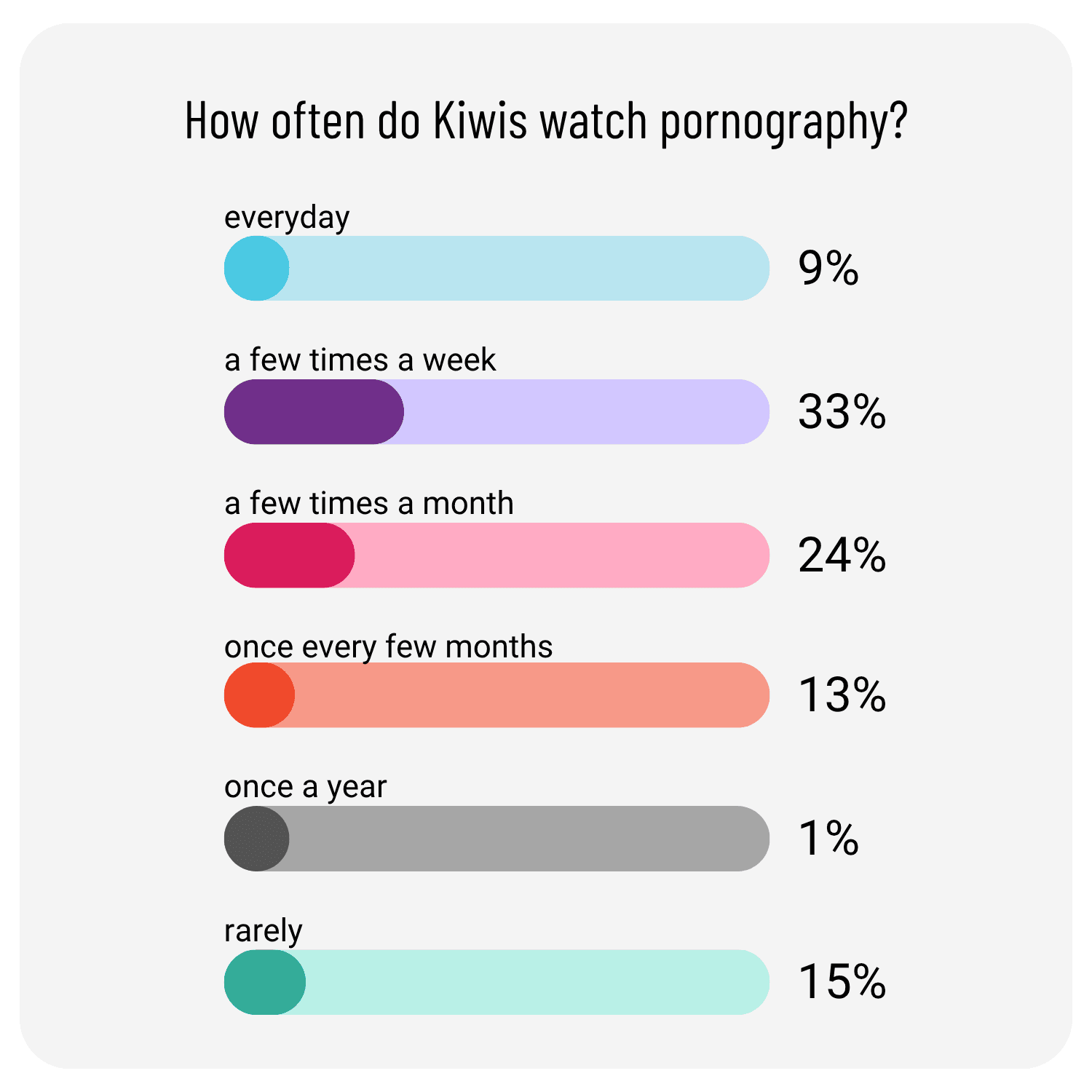
Interestingly, 18 – 23-year-olds were most likely to report watching porn every day, with 13% of them doing so. And this makes sense.
We know that porn is everywhere in the digital age, and it’s easy to stumble upon it online, whether you intend to or not. And there’s a growing global push to ban porn for under-16-year-olds by instating age-verification requirements. Of course, the same digital world that has made porn so pervasive has also created simple ways of dodging these systems, like VPNs to access these sites from IPs where porn websites aren’t banned. This means that access is still relatively simple, and these bans are unlikely to make much of a difference. But here’s a glimpse of where we are at in 2026 because the stats around first access are pretty grim.
Kiwis are first seeing porn at a young age.
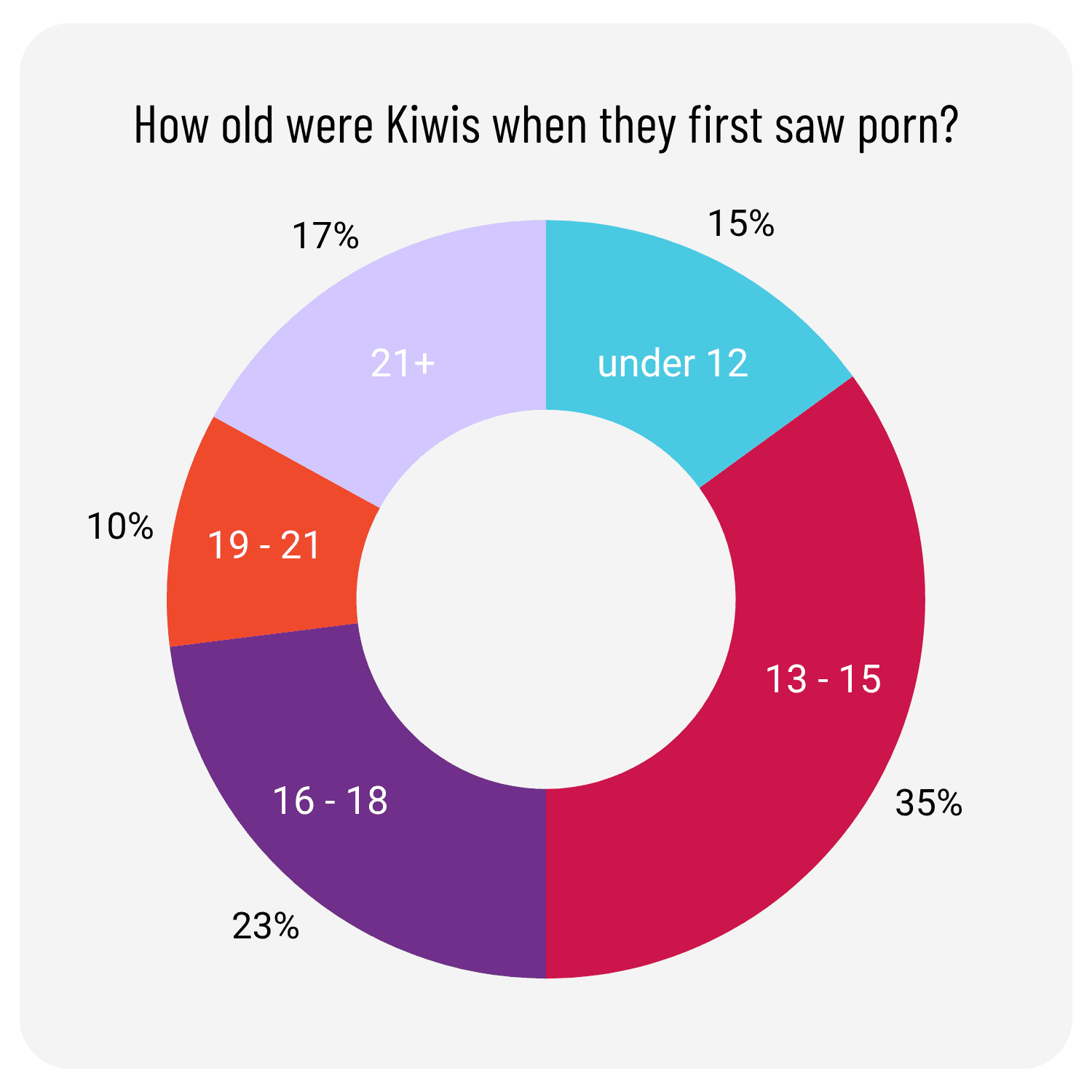
15% of Kiwis saw pornography for the first time before they were 12, while the most common age range was 13 - 15, with 35%. And with access becoming so easy over the last few decades, the percentage of young people seeing porn before the age of 15 has increased.
31% of Gen Z saw porn for the first time before they turned 12, and 46% saw it between the ages of 13 - 15. On the other hand, for millennials, the generation above, only 12% saw it before the age of 12.
What are the actual impacts of porn on young people?
Because yes, young people are taking on board what they see.
Young people were the most likely to report that porn watching had an impact on their real-world sex. 78% of 18 – 23-year-olds reported experiencing the impact of porn in their lives vs 50% of 70+ folks. Young people were also the most likely to report porn creating unrealistic expectations of what real sex is like (42%).
And, for some people, pornography can cause further insecurity about their bodies and sexual prowess. 39% of women report porn has made them feel insecure about their bodies, while 22% of men report the same. But this is higher for trans (53%) and non-binary folks (45%). As trans and non-binary folks tend to be underrepresented in mainstream pornography or portrayed solely as fetishised bodies, these higher percentages make a lot of sense. This is why ethical pornography websites are so important, as they show more diversity in bodies and gender.
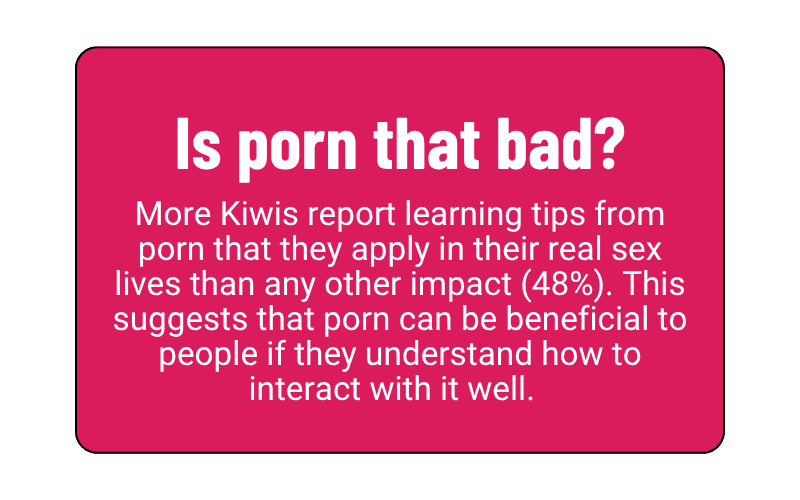
But things aren’t as bad as you might expect. More Kiwis report learning tips from porn that they apply in their real sex lives than any other impact (48%). This suggests that porn can be beneficial to people if they understand how to interact with it well.
- 48% report that porn taught them tips about sex that they’ve taken on board for real-life
- 31% report that porn made them feel insecure about their body
- 30% report that created unrealistic expectations of what real sex is like
- 21% report that porn made them feel insecure about their sexual skills
- 14% report that porn has caused performance anxiety with a partner
And what about the impact of porn on Kiwis relationships?
Well, the good news is that for most of us, it’s not a problem. Only 22% of Kiwis report porn viewing as being a source of friction with a partner. 11% of Kiwis have been upset with their partner's use, and 11% have had a partner become upset with their use. That tracks.
However, when we engage with it well, porn can be a great tool for arousal, and it’s not just for solo play; plenty of couples watch it together, too. 46% of Kiwis watch porn with their partner, with 9% of them doing so frequently. Gen X was the most likely to watch with a partner (60%), while Gen Z was the least likely (34%).
What kind of porn are Kiwis watching?
Kiws really love threesomes. They’re not only fantasising about them and partaking in them, but they are watching them online too. 57% of Kiwis report watching threesome porn, which came out on top for both men and women, and was also the top result for each generation. Lesbian porn had the second-highest viewership (48%), and female orgasm came in third (44%).
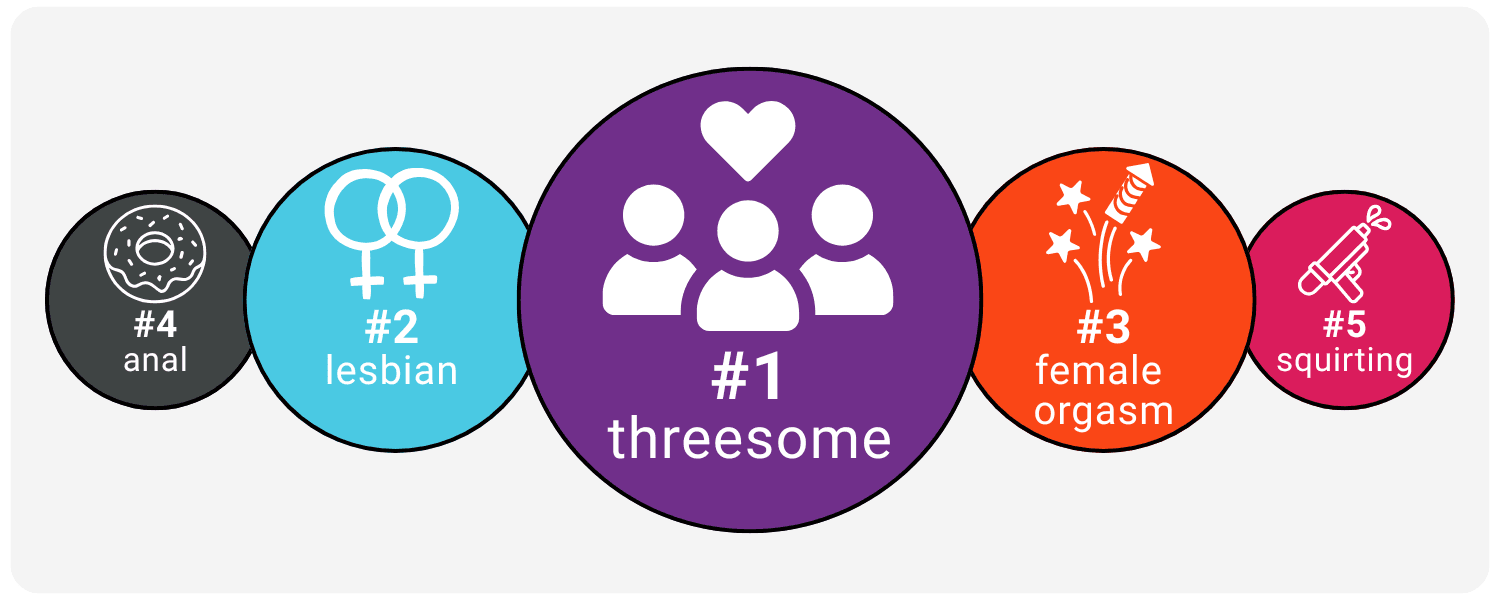
What's the most popular porn category for Kiwis?
- 57% watch threesome porn
- 48% watch lesbian porn
- 44% watch female orgasm porn
- 39% watch anal porn
- 37% watch squirting porn
- 35% watch amateur porn
- 35% watch cream pie porn
- 34% watch rough porn
- 32% watch MILF porn
- 28% watch public porn
- 28% watch gangbang porn
- 28% watch hardcore porn
- 26% watch bondage porn
- 16% watch mature porn
- 15% watch transgender porn
- 14% watch gay porn
- 13% watch hentai porn
- 8% watch cartoon porn
While Kiwis like to watch porn, we can’t say the same for wanting to pay for it…
92% of Kiwis say they don’t pay for porn, with only 0.6% saying they always pay for it. 7% said they use a mix of free and paid services. This raises the question about the quality of porn that Kiwis are consuming, and I don't mean how horny it makes you. Free porn is the least likely to follow ethical practices, pay performers properly and ensure performer safety during filming.
Yes, the stats show we like to watch, but what about making our own porn?
As it turns out, quite a few of us are into making it too. While only 6% of Kiwis have created or shared sexual content of themselves publicly, 40% of us have done so privately. And the younger generations were the most likely to do so. 53% of Gen Z have created or shared sexual content vs 48% of Millennials, 35% of Gen X, and only 19% of Boomers.
08. Sex Education
O oh. Looks like Kiwis are giving New Zealand an F for sex education.
We’ll start on a positive note (don’t get used to it, it’s the only one), 84% of Kiwis report being taught sex education in some form during schooling.
Now, for the bad news, only 15% were satisfied with the sex ed they received. The problem is that formal education is not keeping up with the real-world needs of New Zealanders, especially for queer and gender-diverse people.
When asked if the content in their sex education curriculum catered to their sexuality and gender identity, 57% of heterosexual folks said yes, compared to only 29% of queer folks. And for gender-diverse people, satisfaction levels are even lower, with only 15% of trans and gender-diverse folks saying the curriculum catered to them.
Without meaningful inclusion, these gaps only widen and further alienate LGBTQIA+ youths. And things are about to get worse.
Relationships and sex education (RSE) has long been debated by politicians, educators and parents alike. In 2020, a new curriculum was introduced by the Labour government, developed alongside educators, parents, experts and most importantly, students themselves.
It was the most comprehensive approach we’ve seen in Aotearoa, and it showed: 42% of Gen Z said it prepared them for sexual intimacy, compared to just 15% of boomers.
Then, in April 2025, it was scrapped. The current coalition government has temporarily taken us back to the 2007 guidelines - nearly 20 years old, and completely out of step with young people’s realities in 2026.
So, what do Kiwis wish they had actually been taught more about in sex ed?
The most popular answer was healthy relationships (64%), followed closely by pleasure (63%). For a curriculum about sex, there’s a serious lack of pleasure education, even though this is the primary reason people are having sex.
Sexual boundaries (46%), sexual health (43%) and consent (43%) were other popular topic areas Kiwis felt deserved more attention.
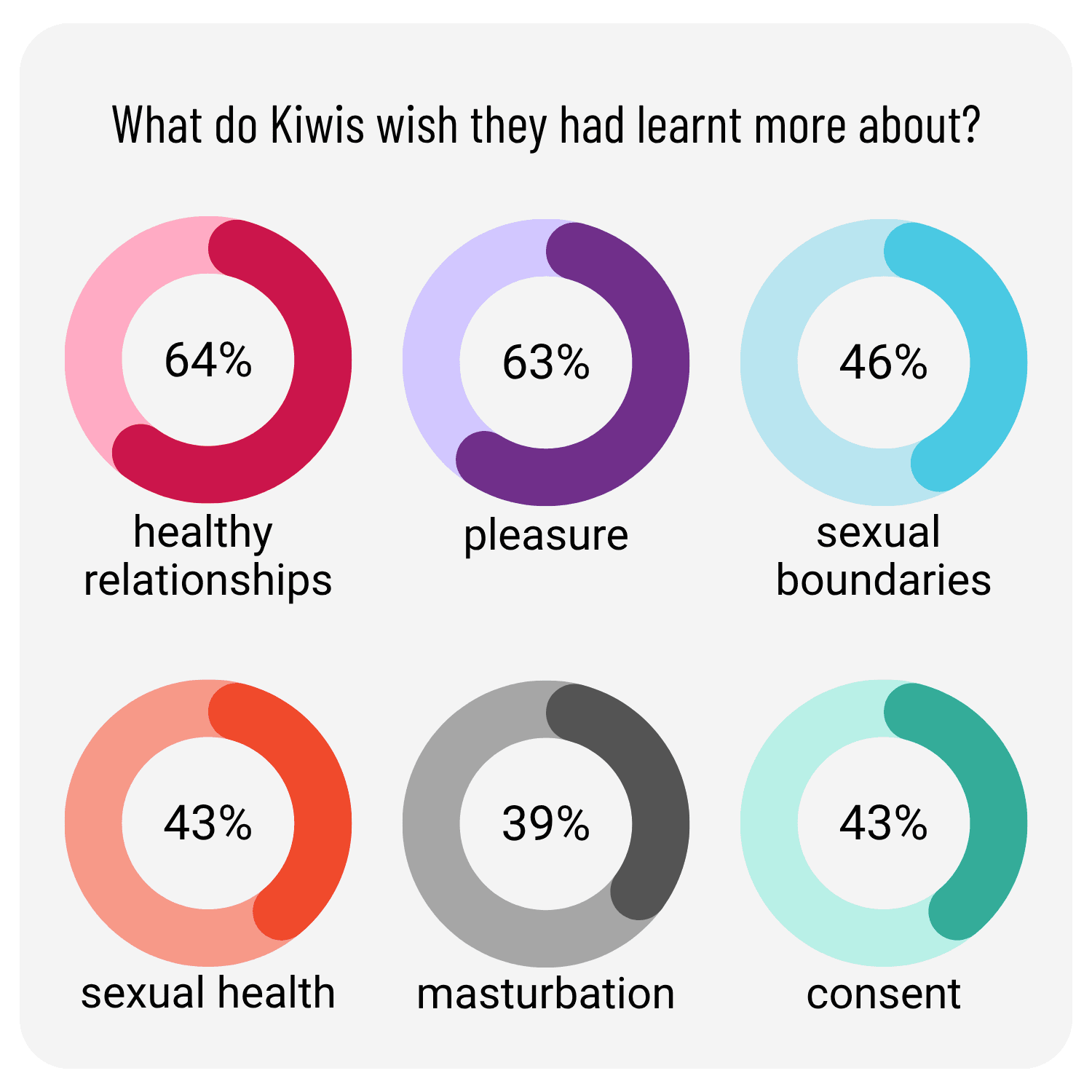
- 64% wanted more information about healthy relationships
- 63% wanted more information about pleasure
- 46% wanted more information about sexual boundaries
- 43% wanted more information about sexual health
- 63% wanted more information about consent
- 39% wanted more information about masturbation
- 36% wanted more information about contraception
- 34% wanted more information about STIs
- 32% wanted more information about anatomy
- 32% wanted more information about porn literacy
- 29% wanted more information about periods
- 26% wanted more information about sexual orientation
- 26% wanted more information about sexual dysfunction
- 24% wanted more information about the reproductive system
- 21% wanted more information about non-heterosexual sex
- 16% wanted more information about gender
09. Safer Sex
It looks like some of the basics of sex education are being missed too, as the stats around safer sex practices in New Zealand have serious room for improvement.
Birth control in New Zealand
45% of Kiwis are currently using some form of birth control. 29% report not currently using it, but having done so in the past, and 26% report never using it at all.
For those that do use birth control, condoms are the most popular form (43%), followed by the IUD (23%), the pill (20%), then surgical interventions such as a vasectomy or having their tubes tied (19%).
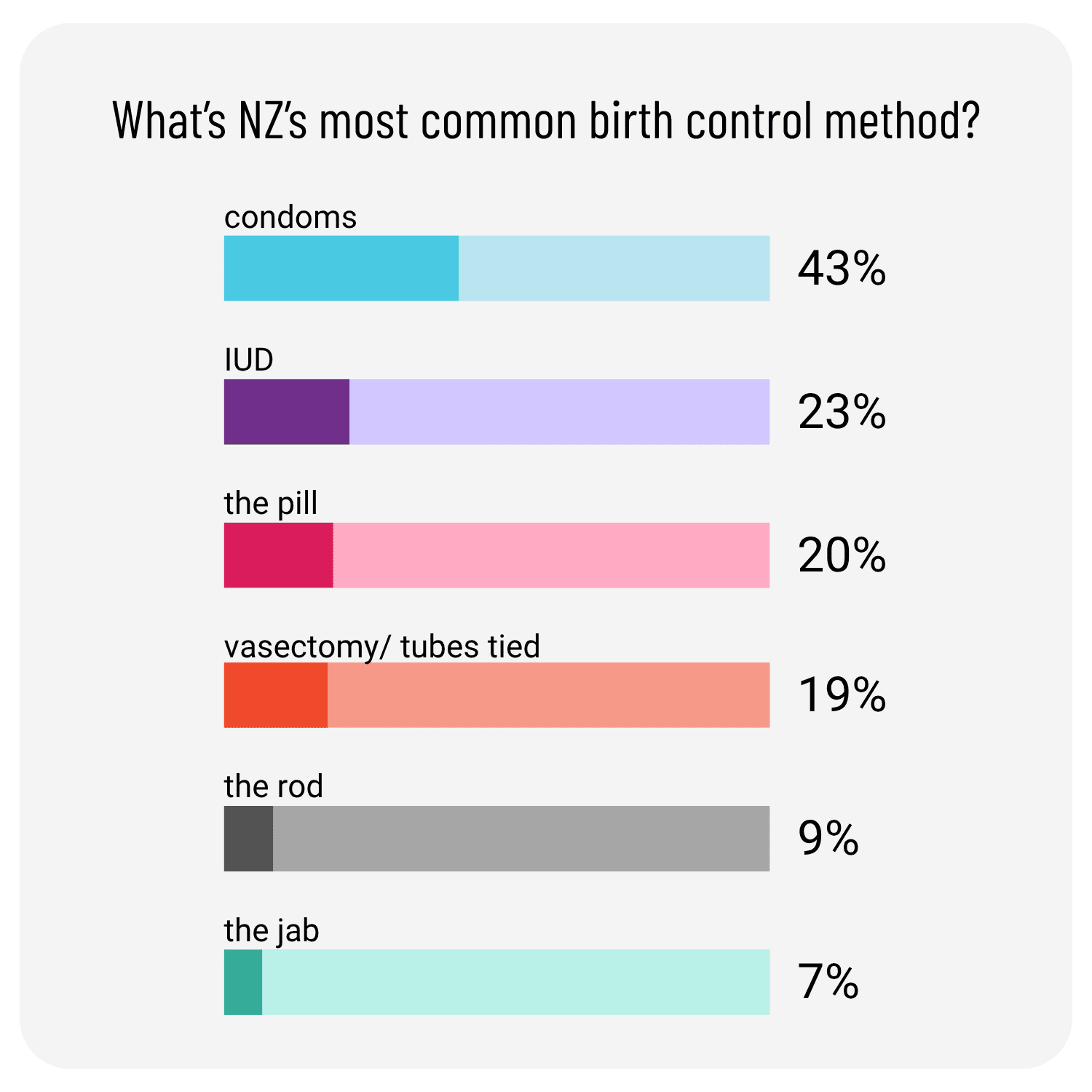
While these are all effective methods for preventing pregnancy, only barrier methods like condoms are going to prevent transmission of STIs.
So, how good are Kiwis at using condoms when they have sex with a new partner?
Unfortunately, the numbers here don’t look too hot.
Only 40% of Kiwis always use condoms during sex with new or casual partners. 48% report using condoms sometimes, and 12% say they never use condoms with new or casual partners.
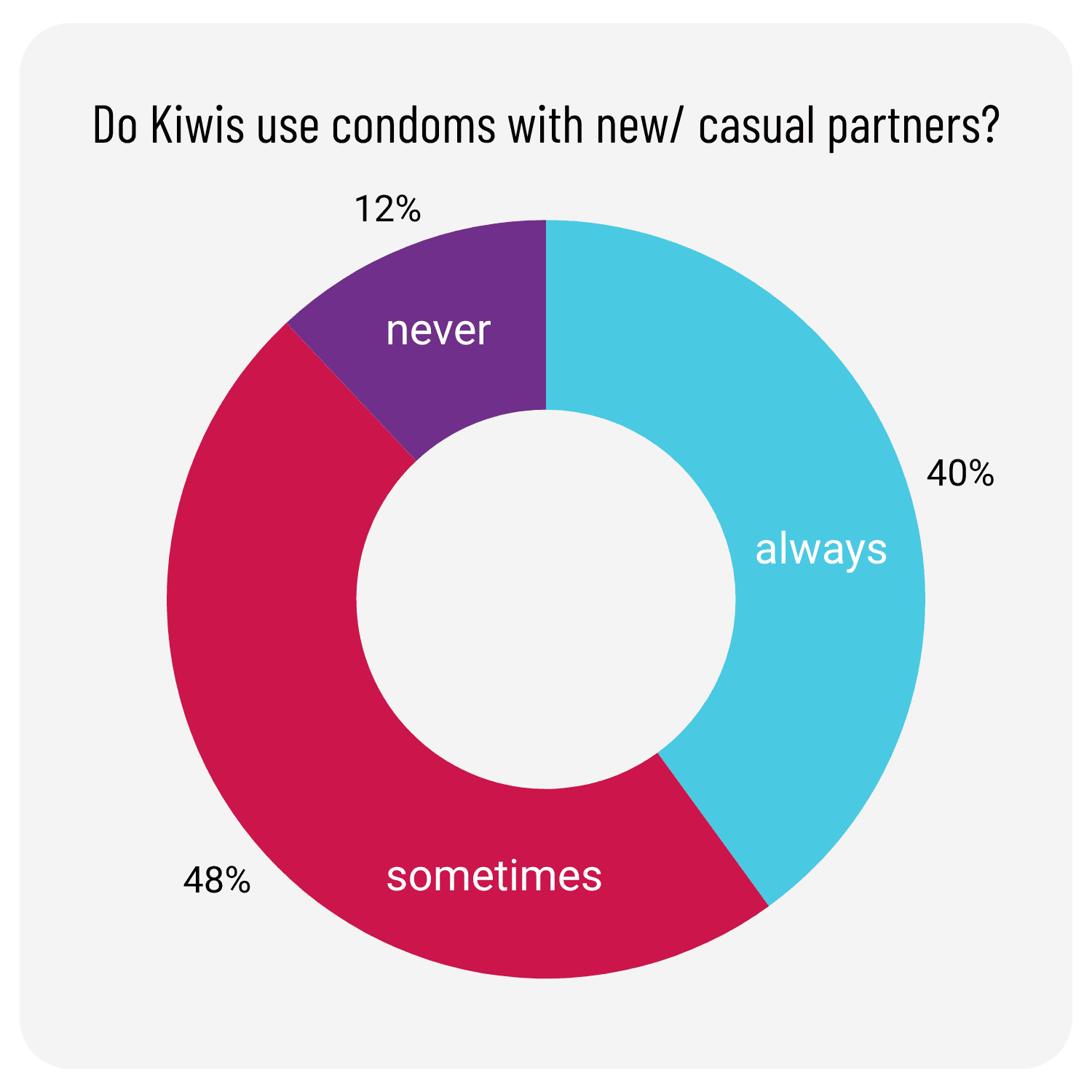
Gen Z were the most likely to report always using a condom with new partners with 42% reporting this, however they were also more likely than any other generation to report never using a condom (16%). Boomers were the least likely to use a condom with a new partner every time (34%), while Gen X reported slightly higher use (37%) and Millennials just higher again with 41%.
With low levels of condom use, that must mean we are really good at getting regularly tested for STIs right? Right...?
Not exactly. Only 70% of Kiwis report being tested for STIs at least once, meaning 30% have never been tested. And there’s a large gender divide in who is getting tested.
Unsurprisingly, women were most likely to have been tested for an STI. 83% of women report being tested while only 55% of men report the same. 71% of trans and non-binary folks also report being tested for an STI at least once.
And its Millennials that are leading the charge for testing. 76% of Millennials have been tested vs only 48% of Boomers.
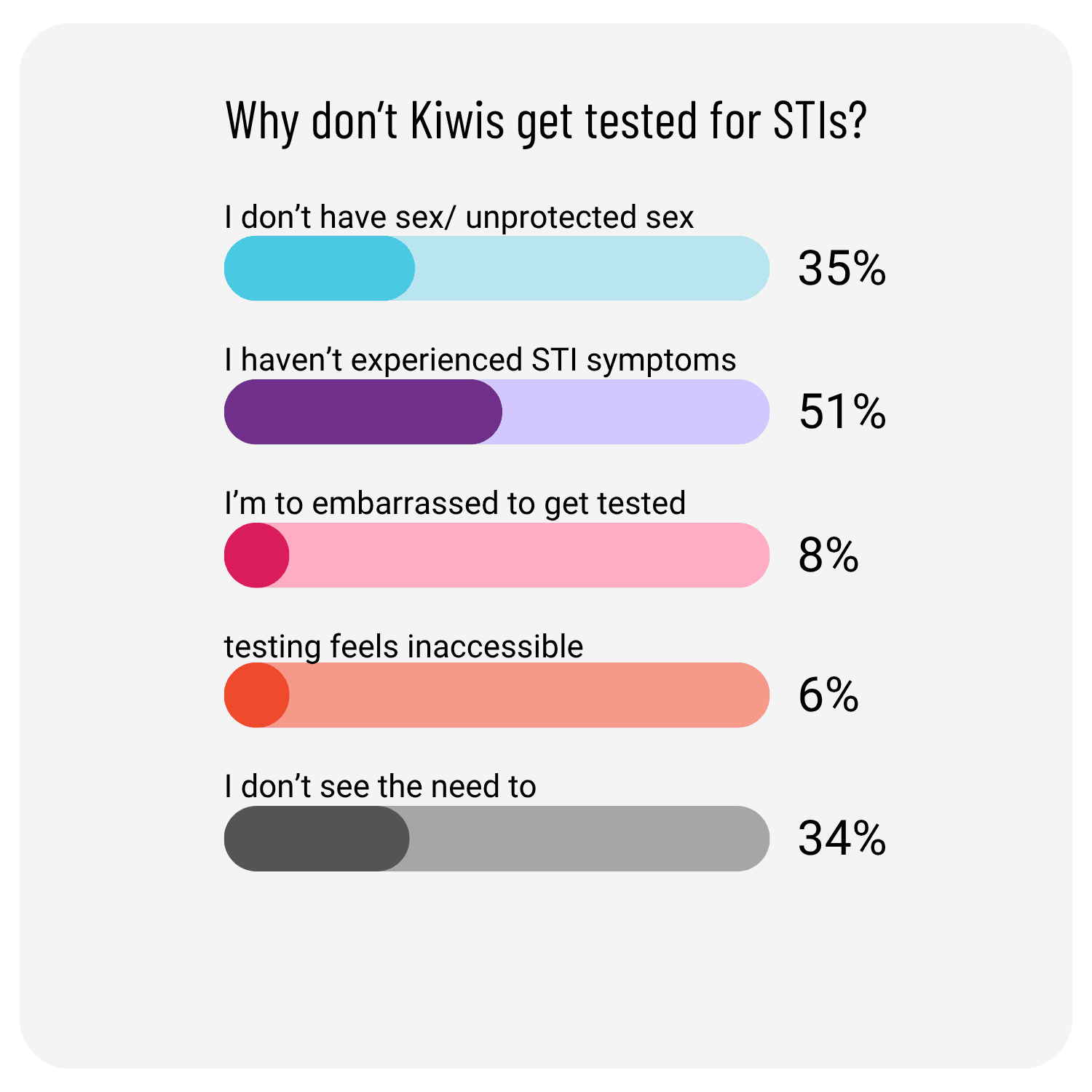
We asked Kiwis why they hadn’t been tested for STIs and the reasons why had some similarities. 51% said that they haven’t experienced STI symptoms and 34% said they don‘t see the need to get tested. 8% said that they were too embarrassed to get tested and 6% said that testing felt inaccessible. Young people were the most likely to report that testing felt embarrassing (11%) or inaccessible (9%), highlighting the need for education around the normalisation of STI testing as part of their overall health and wellbeing.
How prevalent are STIs in New Zealand?
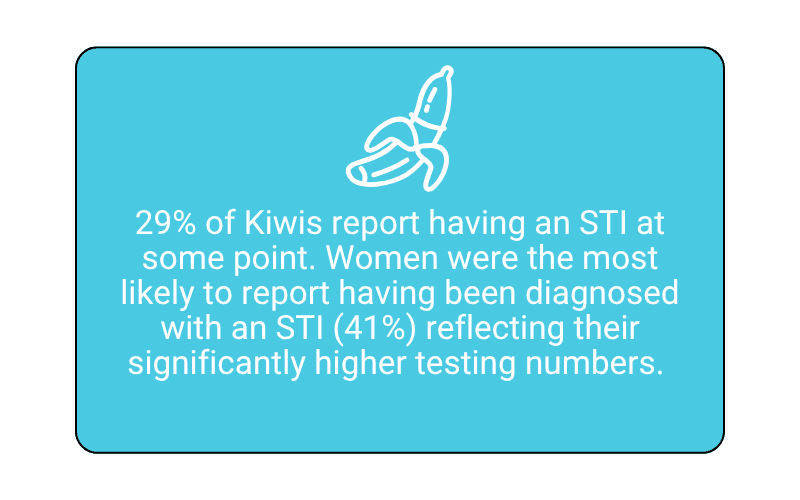
29% of Kiwis report having an STI at some point. Women were the most likely to report having been diagnosed with an STI (41%) reflecting their higher testing numbers. 17% of men, and 13% of trans and gender-diverse folks also report having an STI at some point. But of course, if you aren’t getting tested, diagnosis will be difficult, especially as many STIs have little or no visible symptoms for some people. So, the actual rate of STIs for men and gender-diverse folks is likely higher than reported.
For those that have been diagnosed, these are the most common STIs in New Zealand.
Chlamydia is the most common STI by a significant amount. 72% of Kiwis that have been diagnosed with an STI had chlamydia, 18% had genital herpes, 16% had HPV, 13% had gonorrhea, and 2% had syphilis.
- 72% report having had Chlamydia
- 13% report having has Gonorrhea
- 2% report having had Syphilis
- 18% report having had Genital Herpes
- 16% report having had HPV
Mega Kiwi Sex Survey Summary
The Mega Kiwi Sex Survey aims to fill the research gap about how and why New Zealanders are dating and having sex. This research highlights the importance of normalising conversations and education around sex and pleasure and encouraging Kiwis to keep an open mind. Because, as a nation, we might be kinkier than you think.
Permission to use this content
Adulttoymegastore gives full permission for any media outlets and websites to use the results from our surveys. In return, we request that you properly cite the original source to ensure users can access the original full survey results by linking to the survey webpage.
Please also credit our brand name "Adulttoymegastore" by linking to our home page Adulttoymegastore as the author of the original sex survey results, so our team is properly attributed for sourcing and sharing this content.
For more information, email [email protected]